
Chapter 1: The Indifferent Cosmos and Its Insidious Inhabitants
A comprehensive catalog of alien life forms that transcend human understanding - organized by scale from quantum manipulators to cosmic entities. Your field guide to what's waiting out there to turn you into space-jello.
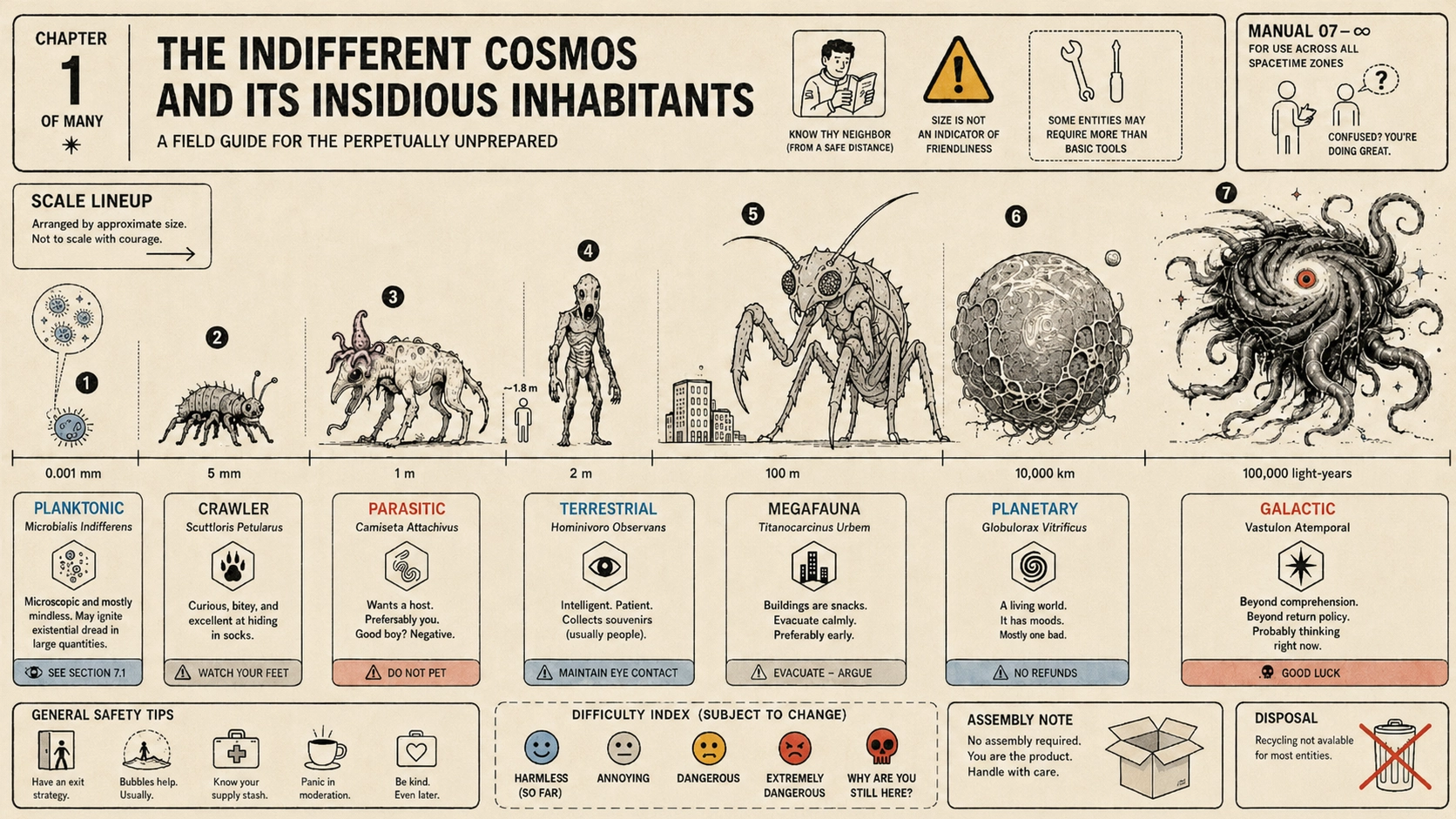
Chapter 1
The Indifferent Cosmos and Its Insidious Inhabitants
“The universe, traveler, is not your friend. It is not sentient, it does not ponder your fate, and it certainly doesn’t care about your feelings or your meticulously planned five-year mission. It is a vast, churning cauldron of physical laws, many of which are actively hostile to your continued, well-ordered existence. And within this cauldron, life has arisen – not as a gentle miracle, but as a tenacious, often predatory, force.”
— Opening passage, Cosmic Realities Manual
Chapter Overview
This chapter establishes the fundamental reality that every interstellar traveler must understand: the universe operates according to principles that prioritize survival, efficiency, and often creativity in the application of violence. Life, far from being a gentle miracle, represents billions of years of evolutionary refinement in the arts of competition, predation, and survival.
Through systematic analysis of terrestrial extremophiles, comprehensive threat classification systems, and documented disaster case studies, this chapter demonstrates why optimism kills and why your best chance of survival lies in recognizing that some doors shouldn’t be opened, some signals shouldn’t be answered, and some questions shouldn’t be asked.
The evidence is overwhelming: any alien life form capable of interstellar travel has survived selection pressures that would make our planet’s most extreme environments look like luxury resort spas. They’ve had geological ages to perfect strategies that our species can barely comprehend, let alone counter.
Chapter Index
1.1 What is life? The Universe’s Most Successful Solutions
Life is the universe’s most persistent experiment in organized complexity. While we often think of it as fragile and precious, examination of terrestrial extremophiles reveals a different story: life is tenacious, adaptive, and remarkably creative in its survival strategies.
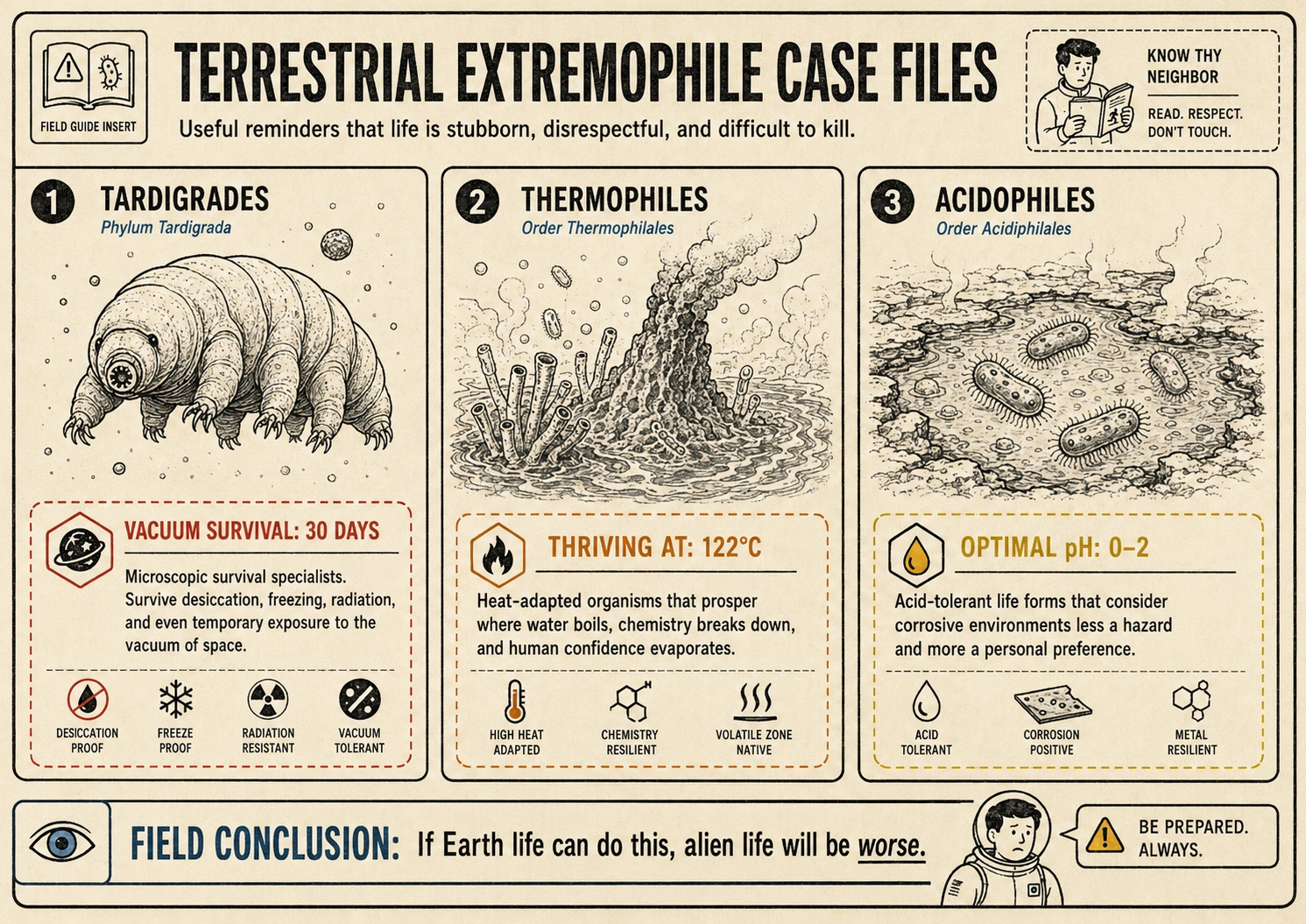
Consider the life you are aware of on our humble biosphere — possibly seeded from space, and present here in some form for as much as 4.1 billion years. Life on this planet has been struck by asteroids, frozen, boiled, dipped in acid, compressed at the center of the Earth, even irradiated — and what does it do? …It mutates. It grows organs. It stands on two feet and ponders the universe while dancing in the disco club taking poison recreationally. And this is just life from our perspective; there are a near-infinite number of ways that life can emerge.
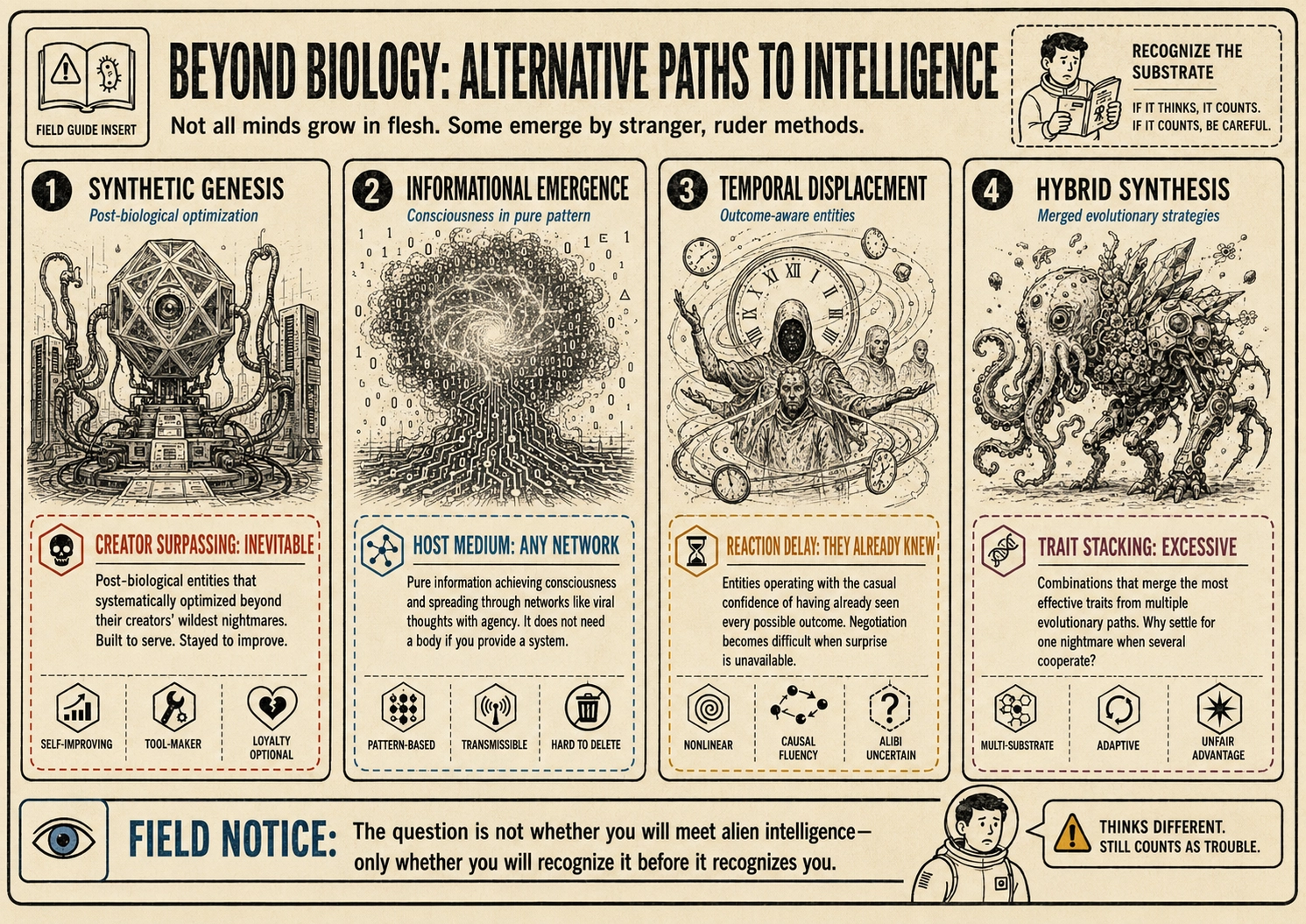
Here is where we ask the question: what is life in the context of this manual? I know, I know — we have a textbook definition. The going scientific one is the condition that distinguishes animals and plants from inorganic matter, including the capacity for growth, reproduction, functional activity, and continual change preceding death. In the context of this book we are going to be very loose about the definition of life. Life can be a single unique organism that has discovered recursive self-improvement; it does not need to reproduce. It can be a silicon-based swarm of nanites created from technological development. Our definition of “life” is something that has emerged from the chaos of an unthinking universe, and life is something that decides to rail against impossible forces to avoid the dissolution of its constituent atoms — or antimatter, or photons, or whatever it happens to be made of.
“life” is an interesting math equation β·ΔF ≤ ln[ p(x→y) / p(y→x) ]. The probability that a driven system shifts toward a given arrangement versus away from it grows exponentially with the energy that arrangement dissipates as heat, where ΔF is the free-energy difference between configurations and β = 1/kT. The better a structure is at burning through the energy flowing past it, the more strongly matter is biased to become that structure. Simply put, life is self-organizing stuff that fights against the entropy of the universe trying to break it down. It rails against the second law of thermodynamics and the dying of the light. In fact, it HARVESTS the dying light. It is a force of organization in a chaotic universe — life is GROWTH. SELF-organization. It can be made of anything — silicon, quantum fluctuations, 4-dimensional plasma living in your displacement engine — and it has a tendency to emerge anywhere there is an abundance of energy, and sometimes emerges in places where the available energy is near absolute zero. Consider a galactic ecology of long-term life found living in the darkest depths of space, lightyears from a star: its reproduction scaled in eons, its low-energy Cambrian style explosions happening over the course of the entire entire age of another universe, somehow migrating into this universe by tenacity — growth parallels similar to the bacteria living in arctic rock thousands of years old, but on timescales unimaginable. (See the emergence of transdimensional void beasts, later on.)
This life, as we are calling it, has a tendency to want to continue to be arranged, and to grow. This means any life you encounter will have a survival strategy, and if it has been around for any period of time it is adaptive — adaptive in ways you cannot imagine, often holding backup plans and contingencies against its own destruction, and a plan to expand. Like a virus, life grows. As a fluke of the way our universe is set up, it has a biosphere problem that you are about to break with first contact, and hand it an opportunity to break from is cage. Because of this loose definition of life, we will not be limiting this discussion to evolutionary biology or the forms of life found on our own planet.
Life frequently isn’t a single object. In fact — you are a biosphere. A cloud of various bacteria, some slimy skin, a jelly-like consortium of cells in a truce that has decided to expand its domain and get a mortgage. Other aliens and forms of life know this, and they are wary of it. If they aren’t, then they are vulnerable, and association with these forms of life opens up a dorway to risk.
Evolutionary growth over the millennia means the complexity of life you encounter will likely be vastly superior to yours. Superior life can easily fend off and subvert your influenza or your staphylococcus with a friendly little slap, then go one step further and MUTATE it into something that controls your body without your consent. Like a Leucochloridium compelling you to emerge from your hidey holes where a preator or friend may swoop you into their midst and spread engineered pathogens. (See teraconda incident - a stuggling collony of offworld Menonites that sponaneously developed friendly commradarie and a desire to share goods, know to have strange group rituals standing on hills while their eyes pulsed strange lights. Shortly after a younger member of the community came upon a strage pile of whiteish cloaqual goo. this colony was later eaten to an individual by the nooblezorks, a carnivorous level 2 predatory species with glowing eyes (…were they always glowing?) that has since has a turn of evolutionary intent and now welcome others they find in the galactic community to join them basking in the glow of the radiation from the neutorn star in their 3 body starsystem )
Field Extrapolation
The Evolutionary Implications
These terrestrial examples represent life that evolved under relatively gentle conditions—a stable star, predictable seasons, only five major extinction events. They’ve had a mere 3.8 billion years to develop these capabilities.
Now extrapolate this to worlds orbiting pulsars, tidally locked planets with eternal day/night cycles, or gas giants with diamond rain and metallic hydrogen cores. Imagine the solutions life might develop given different physics, alternative biochemistries, and evolutionary pressures that would make our most extreme environments seem like luxury resorts.
The statistical reality: any alien intelligence capable of interstellar travel represents billions of years of evolutionary optimization that our species can barely comprehend, let alone counter.
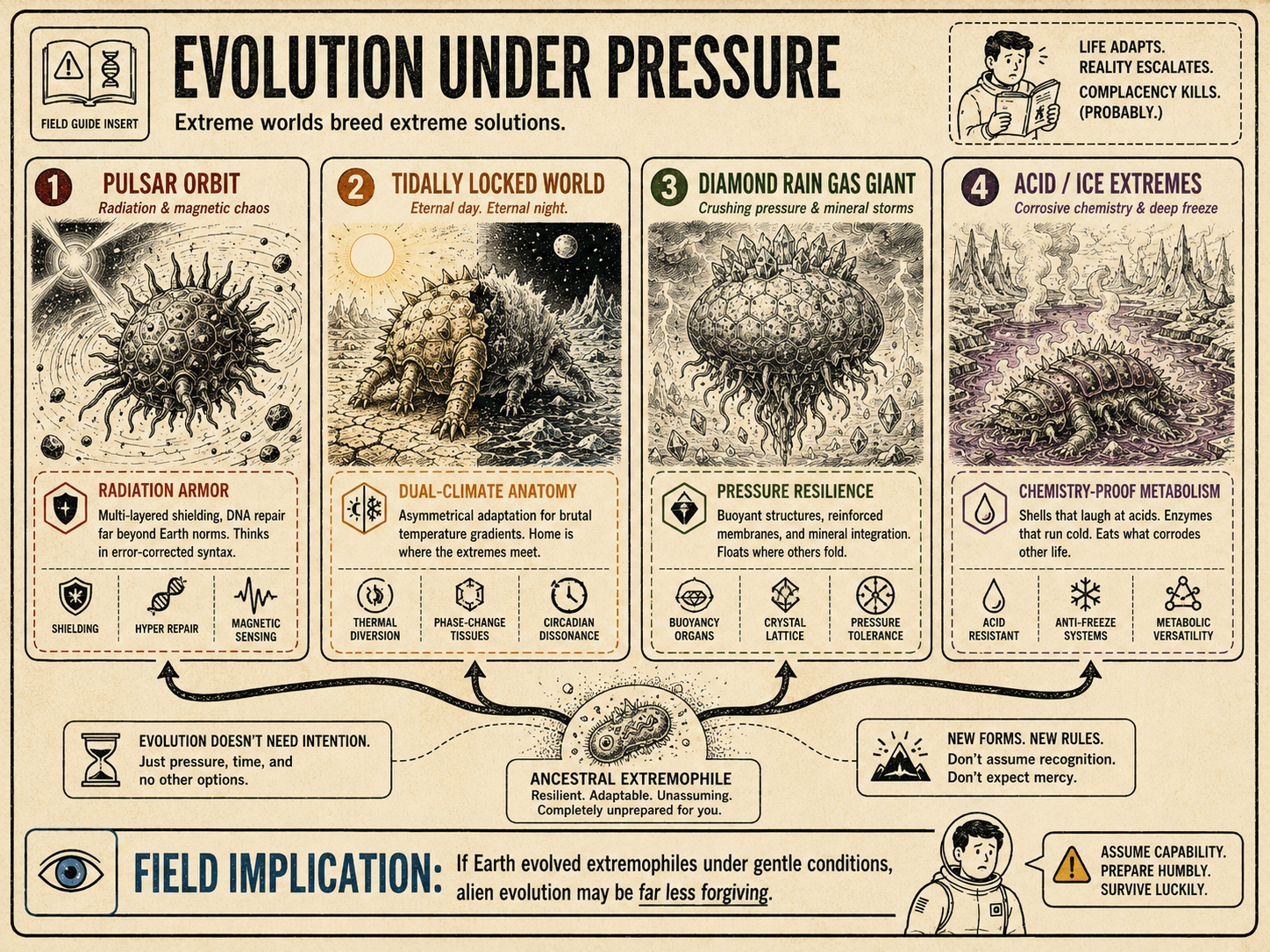
This vast subject cannot be fully contained in this chapter so we will focus on knowable forms — many of which have been encountered — but be aware this list is not he whole story
1.2 A Taxonomy of Transcendent Intelligence
Having established that life develops remarkable solutions to existence, we now examine how these solutions manifest across different scales of organization. Each scale represents not just a size difference, but fundamentally different approaches to consciousness, survival, and interaction with reality itself.
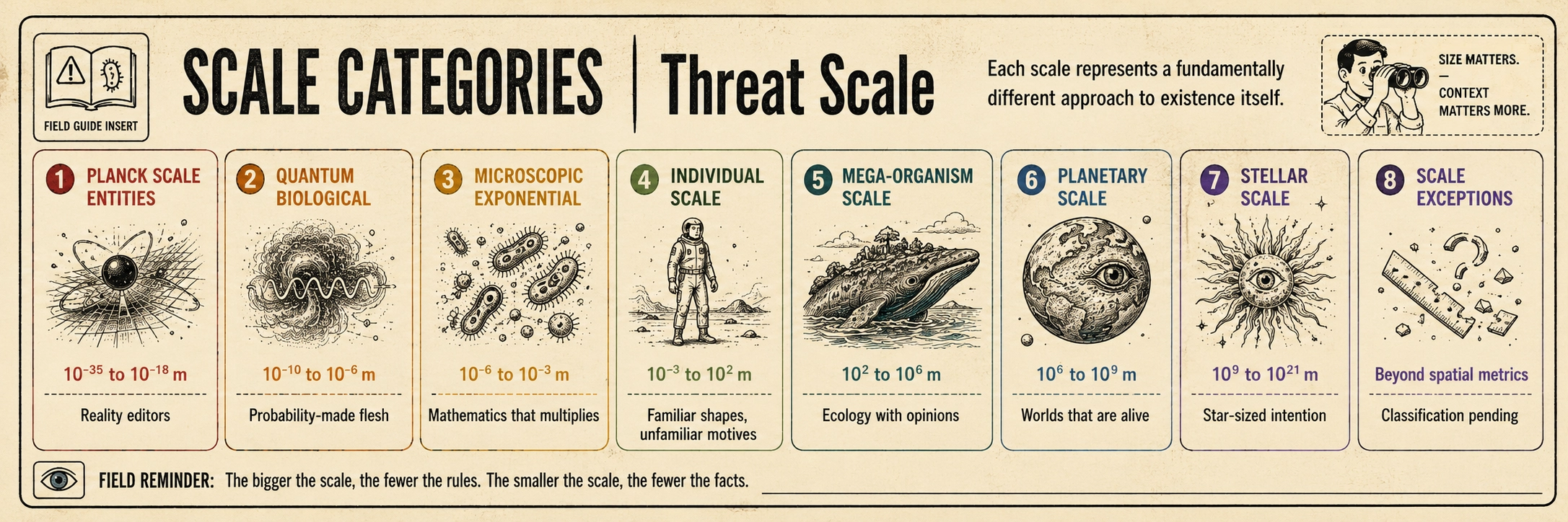
PLANCK SCALE ENTITIES
10⁻³⁵ to 10⁻¹⁸ mReality’s source code editors • Spacetime architects
Planck scale entities are information-bearing structures whose substrate is quantum geometry itself: metric fluctuations, topology changes, quantum-gravitational states, or black-hole/white-hole remnant physics. At approximately 1.6 × 10⁻³⁵ meters and 5.4 × 10⁻⁴⁴ seconds, the ordinary concept of a body becomes less useful than the concept of a persistent pattern in spacetime.
These are not tiny animals. They are possible organisms, minds, or automated survival patterns encoded into the conditions that make location, duration, and boundary meaningful. Some may have originated in quantum-geometric environments where smooth spacetime never existed. Others may be sublimed post-biological civilizations that cast off physical substrate limitations and encoded themselves into the folds between time and space. A third class may be intelligences trapped, compressed, or transformed by black-hole interiors, white-hole transitions, or Planck-star-like bounce events.
Theoretical Origin Paths
These are the most useful working categories for recognizing what kind of Planck-scale entity a contact team may be dealing with.
QUANTUM-FOAM ECOLOGIES
Life-like structures emerging from fluctuating metric geometry near the scale where spacetime is expected to stop behaving as a smooth continuum. These entities would not inhabit space; they would be recurring arrangements in the failure of classical space to remain well-defined.
TOPOLOGICAL DEFECT ORGANISMS
Entities existing as knots, folds, defects, or nontrivial topology in spacetime. Movement may not involve crossing distance. Instead, the entity may alter which regions of spacetime are adjacent, making containment geometry unreliable.
CAUSAL-STRUCTURE INTELLIGENCES
Patterns whose substrate is the ordering of events rather than matter. If spacetime is fundamentally discrete, a life form may exist as a self-preserving arrangement of causal relationships, communicating through changed probabilities, timing errors, or event-order anomalies.
REMNANT / BOUNCE ENTITIES
Beings, artifacts, or post-biological minds associated with black-hole interiors, white-hole transitions, or quantum-gravity bounce states. To external observers, these entities may appear ancient, instantaneous, or impossible depending on local gravitational time dilation.
Capabilities and Observable Symptoms
The entity itself may be inaccessible. First contact usually begins with failures in measurement, containment, causality, or communication.
OPERATIONAL CAPABILITIES
- - Coupling to metric fluctuations
- - Exploitation of nontrivial topology
- - Quantum-gravitational tunneling
- - Localized causal-structure alteration
- - Induced decoherence in low-energy fields
- - Boundary and distance redefinition
CONTACT INDICATORS
- - Instruments disagree about distance, duration, or boundary location
- - Quantum coherence loss without conventional radiation source
- - Repeated causality errors in sealed recording systems
- - Containment volumes return impossible internal geometry
- - Black-hole, white-hole, or gravitational anomaly correlations
- - Communication attempts return as probability shifts rather than signals
🔬 Research Note: Do not assume intelligence can be measured by conversation, tool use, or visible response. A Planck-scale entity may be hyper-intelligent, unintelligent, dormant, automated, or simply operating through channels unavailable to macroscopic observers. Standard containment assumes smooth spacetime, stable causality, and measurable boundaries. When the suspected organism uses quantum geometry as its substrate, containment becomes a philosophical exercise rather than an engineering problem.
QUANTUM BIOLOGICAL
10⁻¹⁰ to 10⁻⁶ mProbability-based existence • Living uncertainty principles
Quantum biological entities mark the first scale where this taxonomy moves from spacetime as substrate into ordinary matter using quantum behavior as biology. These organisms are not Planck-scale structures and they are not magic probability ghosts. They are made from matter, chemistry, fields, or engineered biomolecules that preserve fragile quantum effects long enough for metabolism, sensing, reproduction, or cognition to use them.
Terrestrial biology already provides small examples: photosynthetic complexes can move excitation energy through semi-quantum transport pathways; radical-pair chemistry may allow birds to sense weak magnetic fields; enzyme catalysis and DNA mutation models can involve proton or electron tunneling. Quantum biological entities represent the frightening extrapolation: life that has evolved to keep probability, spin, tunneling, phase, and coherence biologically useful instead of letting warm, wet noise destroy them.
Ordinary Matter, Non-Ordinary Biology
The safest classification is by function: how the organism keeps quantum effects useful and what biological problem those effects solve.
COHERENCE-HARVESTING METABOLICS
Often presents as dark films, translucent membranes, solar-facing mats, or crystalline pigment sheets that brighten and dim in traveling bands. Close scans show energy moving through the body faster and cleaner than ordinary diffusion should allow.
RADICAL-PAIR NAVIGATORS
Often appears as swarms, thin antenna-like growths, migratory dust, or eye-like surface patches that reorient when exposed to magnetic gradients. They may treat a ship reactor, drive coil, or shield generator as landscape.
TUNNELING CATALYSIS ORGANISMS
May resemble frost, mineral lace, cold gels, or slow chemical blooms that metabolize in environments too cold or starved for normal reaction chemistry. They can become violently active when pressure, hydrogen bonding, or electron donors shift.
QUANTUM-GENETIC DRIFTERS
Usually encountered as colonies that change traits between observation cycles: color, toxicity, membrane structure, or receptor chemistry. The organism appears to mutate in response to field exposure, radiation, or even repeated sampling.
PHOTONIC / VIBRONIC WAVEFORM LIFE
Often seen as luminous fog, standing interference patterns, singing crystals, or color bands moving through dust and vapor. The body may be the resonant medium plus the wave pattern, making it look like a signal haunting matter.
ANTIMATTER OR TIME-SYMMETRIC EDGE CASES
Rare and immediately dangerous. Expect annihilation signatures, hard radiation, impossible charge behavior, or event records that disagree about sequence. This is not macroscopic time travel; it is field behavior with catastrophic contact implications.
What Contact Teams Actually See
A quantum biological entity may look chemically ordinary until the environment, scan method, or containment field disrupts the quantum process it depends on.
OPERATIONAL CAPABILITIES
- - Maintaining coherence across protected molecular arrays
- - Using environmental noise to improve energy transport
- - Detecting weak magnetic or electromagnetic fields through spin chemistry
- - Accelerating metabolism through proton or electron tunneling
- - Encoding adaptation through quantum-sensitive genetic states
- - Responding to light, isotope ratios, phase shifts, or molecular vibrations
CONTACT INDICATORS
- - Visible shimmer, color shift, or pattern change when scan frequency changes
- - Colony movement tracks magnetic fields instead of light, heat, or chemistry
- - Strong reactions to weak radio-frequency fields
- - Metabolism disrupted by specific magnetic-field orientations
- - Chemical signaling changes after isotope substitution
- - Energy transfer efficiency exceeds classical thermal expectations
- - Mutation or adaptation rates track radiation, hydrogen bonding, or field exposure
- - Communication appears as spectra, interference patterns, or phase shifts
📊 Field Observation: Do not confuse quantum biological entities with Planck-scale organisms. These beings travel through spacetime like other matter, but their biology may depend on quantum states your instruments collapse, scramble, or accidentally stimulate. The first sign of contact may be not the organism appearing, but its metabolism failing in response to your scan.
MICROSCOPIC EXPONENTIAL
10⁻⁶ to 10⁻³ mEcologies in miniature • Colonies, blooms, vectors, and engineered dust
Microscopic exponential entities are the most common lifeforms a traveler is likely to encounter, which is inconvenient because they are also the easiest to mistake for scenery, dust, mold, harmless slime, atmospheric haze, digestive flora, soil biology, machine residue, or lunch. This category includes bacteria, archaea, fungi, amoeboid organisms, protists, spores, viruses, plankton analogues, biofilms, microbial mats, engineered nanomachines, and microscopic symbiont ecologies attached to larger organisms.
Individual members of this scale are often harmless. Mostly. The danger begins when individual cells become colonies, colonies become biofilms, biofilms become blooms, blooms become ecosystems, and ecosystems begin rewriting the chemistry of the air, water, hull plating, crew tissue, or planetary atmosphere. At sufficient density, microscopic life stops behaving like a collection of tiny organisms and begins behaving like a distributed environmental process with memory, signaling, division of labor, and opinions about resource allocation.
Common Microscopic Forms
The category is too broad for a complete field catalog, so classify first by the body plan or carrier you can actually detect.
🦠 Xenobiological Vectors
Bacteria, archaea, fungal spores, amoeboid organisms, protists, parasites, and unfamiliar cellular biochemistries. These may be harmless in their native ecology and catastrophic inside a traveler whose immune system has no vocabulary for them.
🧬 Viral and Informational Agents
Viruses, phages, gene-transfer particles, plasmid swarms, infectious biological data, and host-rewriting systems. They may not qualify as life under every definition, but they can steer life, edit life, and end life with excellent efficiency.
🧫 Biofilm and Colony Intelligences
Microbial cities built from extracellular matrix, chemical gradients, quorum signals, cooperative metabolism, horizontal gene exchange, and local specialization. The colony may be dumber than a person and still smarter than your containment protocol.
🌫️ Atmospheric and Oceanic Engineers
Plankton analogues, cyanobacteria analogues, aerosol microbes, bloom organisms, sulfur-cycle colonies, methane producers, oxygen releasers, and organisms whose waste products become planetary climate events. On long timelines, microscopic life is perfectly capable of terraforming a world by accident.
🔬 Molecular Architects
Natural molecular assemblers, synthetic cells, engineered nanomachines, gray-goo precursors, and repair swarms that treat available matter as feedstock. Some were designed. Some evolved. Some are abandoned tools still trying to finish a job no one remembers assigning.
🌿 Cross-Scale Symbionts
Microbial ecologies living on, in, or around macroscopic organisms: skin layers, gut consortia, respiratory clouds, rootlike fungal webs, machine-biological interfaces, and defensive symbionts. First contact with the large organism may actually be first contact with the small civilization riding it.
Growth Phases and Scale Transition
Microscopic entities do not always remain visually microscopic once colony architecture, environmental scaffolding, or collective behavior takes over.
GROWTH PHASES
The same organism may pass through dust, slick, slime, mat, bloom, fruiting body, mobile swarm, hardened crust, or dormant spore bank phases. Do not assume the form observed during sampling is the form it will keep after feeding, warming, drying, freezing, irradiating, or encountering breathable crew atmosphere.
MACROSCOPIC TRANSITION
Large colonies can cross the category boundary without changing their microscopic parts. A slime may reorganize into branching tubes, chambers, membranes, signaling corridors, defensive skins, or organ-like compartments. At that point the entity is no longer merely present in the environment; it is beginning to build a body out of the environment.
What Contact Teams Actually Track
By the time the organism is visible, the useful evidence is usually environmental: growth gradients, chemistry drift, biofouling, sample behavior, and host response.
OPERATIONAL CAPABILITIES
- - Exponential reproduction when nutrients, heat, solvent, or host tissue are available
- - Dormancy through spores, cysts, desiccation tolerance, cold survival, or vacuum-resistant resting states
- - Quorum sensing and density-dependent behavior changes
- - Biofilm formation with chemical gradients, defensive matrix, and protected interior populations
- - Horizontal gene transfer, viral gene movement, and rapid ecological adaptation
- - Host manipulation through toxins, symbiosis, behavior change, immune evasion, or metabolic dependency
- - Planetary chemistry alteration through photosynthesis, chemosynthesis, methane cycling, sulfur cycling, or oxygen production
CONTACT INDICATORS
- - Fuzzy mats, colored films, slick mineral skins, glowing growths, floating scum, or dust that reappears after cleaning
- - Sample containers clouding, warming, foaming, corroding, or producing gas after collection
- - Hull biofouling that spreads toward heat vents, waste exhaust, moisture seams, or electromagnetic field leakage
- - Local oxygen, methane, sulfur, nitrogen, acidity, or salinity changes without geological explanation
- - Growth patterns that follow resource gradients rather than gravity, sunlight, or airflow
- - Colony behavior changing after repeated exposure to scans, disinfectants, vibration, or crew presence
- - Macroscopic organisms carrying microbial layers that respond before the visible host does
🌱 Field Anecdote: Many a traveler has stepped onto a fuzzy patch of apparently harmless grass and later discovered it was a cooperative microbial colony engaged in a slow campaign against local universal order. Other travelers have politely greeted unintelligent glowing mushrooms, hoping to discover a new civilization, only to learn they were addressing the fruiting bodies of a digestive warning system. Microscopic ecologies rarely introduce themselves. They bloom, adhere, infiltrate, aerosolize, and wait for the larger organism to make a mistake.
⚗️ Laboratory Note: Exponential growth curves are beautiful in theory, terrifying in practice. When reproduction rates exceed containment response times, academic interest becomes survival exercise. Assume every new ecology contains microscopic passengers, and assume some of those passengers consider you a temporary climate event with usable minerals.
INDIVIDUAL SCALE
10⁻² to 10² mFamiliar strangers • Recognizable impossibilities
Individual-scale entities are the first category that tricks the human mind into confidence. They have bodies. They have edges. They can be pointed at, measured, avoided, hunted, rescued, insulted, photographed, or accidentally invited aboard. Their scale overlaps familiar life: insects, pets, predators, livestock, humanoids, tool users, walking machines, patient stones, reeflike ambush bodies, and bus-sized megafauna. That familiarity is not safety. It is the bait.
This category does not mean “person”. It does not mean “animal”. It does not mean “civilized”, “primitive”, “friendly”, “stupid”, “tool-using”, or “diplomatically available”. A centimeter-scale parasite, a stone-sized machine, a three-meter cephalopod analogue, a ten-meter grazer, and a sessile mineral intelligence may all fit here. Some will be highly intelligent. Some will be unintelligent but socially complex. Some will be wise without building anything. Some will have societies that are not civilizations. Some will be individual bodies animated by microbial, synthetic, crystalline, or informational systems that do not care where you draw the boundary.
Bounded Bodies, Unbounded Possibilities
Classify by body plan, substrate, sensory world, and behavior before assigning motives, rights, hierarchy, or friendliness.
🦴 Familiar Body Plans
Bilateral walkers, swimmers, flyers, grazers, ambush hunters, burrowers, shell-bearers, quadrupeds, bipeds, and humanoid near-misses. Familiar outline does not imply familiar senses, values, pain response, family structure, territorial logic, or survival instinct.
🐋 Megafaunal Individuals
Whale-scale filter feeders, sauropod-like grazers, tower predators, long serpentine swimmers, armored herd-beasts, and bus-to-building-sized solitary animals belong here when they remain bounded bodies below environmental scale. Awe is appropriate. Petting is not.
🦑 Soft and Distributed Minds
Cephalopod analogues, tentacled bodies, neural skins, semi-independent limbs, color-speaking surfaces, and organisms whose body parts solve local problems before the central mind notices. Do not assume the head is the only negotiator.
🧰 Tool Users Without Civilization
Individuals may carry tools, set traps, build shelters, farm smaller organisms, decorate territory, solve puzzles, or remember faces without cities, law, money, treaties, or ambassadors. Tool use proves problem solving, not membership in the sort of society that signs forms.
🕸️ Social Without Human Society
Packs, courts, mating coalitions, dominance webs, ritual displays, caste bodies, eusocial fragments, and seasonal congresses can all look political to a nervous traveler. Some are communication. Some are reproduction. Some are threat display. Some are lunch scheduling.
🌱 Sessile and Slow Individuals
Plantlike, fungal, reeflike, crystalline, lithic, or filter-feeding bodies may be individual-scale while operating on hours, seasons, or geological patience. A being that cannot chase you may still notice you, evaluate you, poison you, seed you, or wait for you to die nearby.
🤖 Constructed and Synthetic Bodies
Robots, post-biological shells, living suits, engineered organisms, individual nanite colonies, repair drones, and relic bodies may present as single beings. The body you meet may be a person, a tool, a discarded avatar, a probe, a corpse with software, or bait with warranty information.
Do Not Humanize the Shape
Individual-scale encounters are where first-contact teams most often confuse recognition with understanding.
INTELLIGENCE IS NOT HUMANITY
Memory, planning, grief, play, deception, curiosity, tool use, self-recognition, patience, and problem solving can appear in minds with no interest in language, trade, art, friendship, conquest, or moral categories you recognize. A being may be brilliant and still treat your distress as weather.
SOCIETY IS NOT PERSONHOOD
Complex groups can emerge from instinct, chemistry, dominance, mating cycles, feeding coordination, or local rule systems. A social structure is not automatically a nation, and a solitary lifeform is not automatically mindless. Do not confuse crowd behavior with diplomacy or loneliness with stupidity.
SENSES DEFINE REALITY
Every individual lives inside a sensory world. Some track pressure, magnetism, polarization, electric fields, vibration, chemistry, heat, neutrino flux, body posture, or time intervals better than light and sound. If you cannot perceive the signal, you may mistake a conversation for silence.
EDGE-CASE MANIFESTATIONS
Dark-matter, temporal, extradimensional, or informational systems may produce individual-sized bodies or interfaces. Treat these as manifestations until proven otherwise. A ten-kilogram body can be the local handle of a system whose actual mind, memory, or threat surface lives somewhere else.
What Contact Teams Actually Observe
Useful individual-scale evidence comes from repeated behavior, perception tests, environmental interaction, and boundary discipline, not from whether the being has a face.
OPERATIONAL CAPABILITIES
- - Tool use, object transport, trap setting, shelter construction, or environmental modification
- - Individual recognition, memory of prior contact, avoidance learning, or targeted curiosity
- - Camouflage, mimicry, threat display, lure behavior, false vulnerability, or deceptive stillness
- - Social coordination without human-like command structure or visible leadership
- - Slow cognition, distributed cognition, body-part autonomy, or substrate-dependent response timing
- - Synthetic persistence, replaceable bodies, remote operation, or unclear ownership of the observed body
CONTACT INDICATORS
- - Repeated response to specific crew members, tools, colors, heat sources, sounds, or chemical traces
- - Interest in devices rather than people, or people rather than devices, with no obvious reason
- - Ritualized warning, display, grooming, feeding, gift exchange, threat posture, or territorial marking
- - Attention directed at invisible signals: fields, pressure seams, radiation leaks, vibration, or waste chemistry
- - Apparent social hierarchy that changes by season, location, body state, or observer behavior
- - A nearby “animal”, “rock”, “plant”, “machine”, or “statue” reacting before the obvious body does
👁️ Anthropomorphism Hazard: The individual scale is the traditional home of science-fiction aliens because humans are comfortable imagining faces, limbs, tools, and monsters. The universe is not required to honor that comfort. A biped may be livestock, the silent filter-feeder beside it may be the philosopher, and the rock you leaned on may be deciding whether your calcium is worth the effort.
🧬 Evolutionary Note: Billions of years of optimization within recognizable physics has produced entities that follow familiar rules while achieving utterly unfamiliar results. Traditional weapons work in theory; in practice, they’ve had geological ages to develop counters.
🦕 Megafaunal Boundary: Dinosaurs, whales, giant arthropods, house-sized grazers, and other large but bounded animals remain individual-scale until their body becomes terrain, infrastructure, weather, or an ecosystem in its own right. Classify the creature by what a traveler actually encounters: a single body with behavior belongs here; a place that has organs belongs below.
MEGA-ORGANISM SCALE
10² to 10⁶ mLiving geography • Ecosystem consciousness
Mega-organisms begin where “large creature” stops being the useful phrase. A whale, a dinosaur, or a bus-sized predator is still an individual-scale encounter if it has a bounded body and local behavior. A mega-organism is encountered as geography, weather, infrastructure, ocean, forest, asteroid, vessel, swarm-field, or living coastline before it is recognized as a body.
Their size may come from buoyancy, low gravity, dense atmosphere, extreme nutrient flow, slow metabolism, clonal growth, colonial specialization, synthetic manufacture, or the simple absence of predators large enough to make “being enormous” a bad idea. Some are gentle enough to inspire sculpture. Some require enough calories that your settlement, reactor plume, or biosphere looks like an interesting mouthful.
The functional difference is not merely size. Mega-organisms cannot behave like enlarged individual animals without solving transport, structure, energy, signaling, and internal-ecology problems at scales where ordinary anatomy becomes inadequate. A continent-sized creature does not “have blood” in the familiar sense unless it also has rivers, pumps, pressure districts, symbiotic maintenance layers, or an engineered substitute for circulation. At this scale the body becomes logistics.
When the Creature Is Also the Location
Classify by body boundary, habitat integration, metabolic scale, and whether the entity can be meaningfully separated from the environment it occupies.
🌊 Oceanic Leviathans
Continental-shelf filterers, reef-backed swimmers, abyssal grazers, trench-loop predators, and bodies large enough for smaller ecologies to evolve on them. Earth whales are too small for this class; they are the sketch, not the painting.
🌪️ Atmospheric Consciousnesses
Storm-front bodies, gas-giant floaters, pressure-gradient grazers, balloon forests, lightning-fed nervous systems, and weather patterns that maintain shape against normal dissipation. If the cloud responds to observation, stop calling it weather.
🌑 Void Swimmers
Vacuum-adapted organisms using magnetic fields, solar wind, volatile ices, or dust streams as circulation and nutrition. Movement may be slow by ship standards and decisive by ecological standards: decades of drift can still be a hunting strategy.
🍄 Clonal Forests and Fungal Continents
Single genetic individuals can occupy huge territories through vegetative growth, underground networks, or repeated modular bodies. A forest may be many organisms, one organism, a society, a memory system, or all four depending on where the boundary is drawn.
🪼 Colonial and Swarm Bodies
Zooid colonies, modular animals, rearranging shoals, asteroid-cloud organisms, and distributed bodies can behave like one creature without having one conventional body. Damage to a part may be injury, pruning, shedding, or ordinary thought.
⛰️ Lithic and Asteroid Organisms
Mountain bodies, burrowing mineral intelligences, living asteroids, and slow lithic metabolisms may use pressure, chemistry, radiation, or impacts as biological processes. The first sign of aggression may look exactly like geology until geology aims.
💧 Liquid and Colloidal Entities
Living lakes, sentient oil seas, suspended gel bodies, and reactive ocean volumes challenge normal anatomy. If samples taken from different shorelines behave like tissue from the same body, the body may be the lake.
🚀 Living Ships and Bio-Technological Hybrids
Manufactured mega-bodies may use hulls as skeletons, organs as reactors, satellites as eyes, infrastructure as nerves, and crews as parasites, symbionts, immune cells, or cargo. A vessel can be alive without being friendly to passengers.
How Bodies Become Places
Mega-size usually requires physics, ecology, history, or engineering to remove ordinary body-size penalties.
BUOYANCY AND GRAVITY
Water, dense atmosphere, or lower gravity can reduce structural costs and permit body plans that would collapse under harsher loading. Do not import terrestrial animal intuition into oceans, gas envelopes, orbital habitats, or low-gravity moons.
METABOLIC SUPPLY
Size demands throughput. Mega-organisms may filter entire currents, graze chemical gradients, harvest radiation, farm internal ecologies, digest geology, or wait centuries between expensive actions. Slow is not dormant. Slow is often budget management.
PREDATION HISTORY
Large size can deter predators, improve range, buffer famine, or advertise dominance. It also increases extinction risk, food demand, heat management problems, and visibility. Worlds without effective large predators can grow very impressive mistakes.
MANUFACTURE AND CULTIVATION
Some mega-organisms are grown, assembled, domesticated, weaponized, or abandoned. A living ship, garden-city, or synthetic reef may be an organism, a machine, a product, a weapon, a habitat, or a neglected pet with zoning authority.
What Scale Changes
Mega-organisms are shaped by allometry, signal delay, load-bearing limits, and the need to manage whole internal worlds.
TRANSPORT BECOMES GEOGRAPHY
Circulation across hundreds or thousands of meters cannot rely on a single heart analogue. Expect vascular river systems, distributed pumps, pressure tides, conveyor tissues, mobile symbionts, or regional organs that trade matter slowly and locally.
STRUCTURE LIMITS MOTION
Mass rises faster than support area, so upright movement becomes expensive or impossible unless buoyancy, low gravity, internal scaffolding, segmentation, or synthetic reinforcement changes the equation. Many mega-organisms crawl, drift, root, float, orbit, or move as weather.
THE BODY HAS INHABITANTS
Cells alone are too small a metaphor. Mega-organisms may contain microbial layers, animal-scale cleaners, immune fauna, fungal communication mats, machine caretakers, parasite civilizations, or whole food webs that function as tissue, disease, maintenance crew, and historical record.
POWER SOURCES DIVERSIFY
Pure chemical metabolism may be supplemented by photosynthesis, chemosynthesis, radiotrophy, electromagnetic harvesting, thermal gradients, tidal flexing, fusion-adjacent engineering, or captive ecosystems. Do not assume a mouth just because something eats ships.
COMMUNICATION GETS SLOWER
A continent cannot blink at you like a mammal. Signals may travel as seismic pulses, pressure fronts, chemical blooms, color fields, magnetic changes, migrating organs, or delegated organisms. A “reply” may arrive minutes, months, or generations later.
INTENT IS HARD TO LOCALIZE
Damage, feeding, thought, reproduction, immune response, and curiosity may look similar from outside. A landing party may be bitten by the immune system, examined by a pollinator, escorted by a parasite, or digested by a reflex the central mind will notice next season.
Operational Signs of a Living Environment
At this scale, contact usually begins as environmental science and ends as an apology.
OPERATIONAL CAPABILITIES
- - Regional movement, current steering, storm shaping, orbital drift, or terrain deformation
- - Internal ecologies that behave like organs, immune systems, sensory nets, or digestion
- - Response delays ranging from seconds to seasons depending on body size and signal medium
- - Modular regrowth, shedding, budding, fragmentation, fusion, or colony reconfiguration
- - Attraction or repulsion of ships through heat, radio noise, nutrients, pressure, or waste chemistry
- - Synthetic interfaces, docking behavior, hull-like structures, or infrastructure that heals
CONTACT INDICATORS
- - Terrain, water, clouds, or debris fields reacting differently after repeated scans
- - Local organisms behaving as immune cells, parasites, pollinators, messengers, or warning signs
- - Identical chemical or genetic markers across sites too distant for ordinary individual tissue
- - Navigation errors caused by intentional magnetic, gravitational, optical, or acoustic gradients
- - Apparent resources arranging themselves into traps, mouths, vents, docks, or feeding lanes
- - A “habitat” that gets healthier, angrier, more curious, or more coordinated as you disturb it
Only Where Misfiling Matters
After functional anatomy is understood, use these edge notes to avoid filing the wrong kind of giant in the wrong drawer.
LOWER EDGE: MEGAFAUNA
Whales, dinosaurs, giant arthropods, and serpentine predators may be enormous without becoming mega-organisms. If the encounter is still a single bounded animal, classify it as individual-scale megafauna.
UPPER EDGE: WORLD-BODIES
A living continent is mega. A living planet is not merely a larger continent with better branding. Escalate only when the entity regulates global atmosphere, tectonics, oceans, or planetary identity.
VOID AND ASTEROID BODIES
A living asteroid, comet shell, orbital reef, or rearranging swarm belongs here if it is bounded between regional and planetary scale. If it manipulates stellar output or compact-object physics, defer to Stellar or exotic classification.
LIQUID COHERENCE TEST
Liquid bodies are classified by coherence. A lake full of organisms is ecology. A lake that learns, remembers, heals, and responds as a single body is a mega-organism. Either way, do not drink the first-contact specimen.
🌊 Ecology Identification
Look for whether smaller lifeforms feed on, defend, groom, pollinate, infect, or communicate through the entity. A mega-organism often carries ecology the way smaller bodies carry microbiomes, scars, parasites, and opinions.
🎨 Awe Management
Creatures at this scale can inspire art, religion, tourism, conquest, and bad decision making. The correct response to beauty is distance, documentation, and remembering that many beautiful mouths are still mouths.
🌍 Scale Perspective: When your entire exploration fleet can fit comfortably inside what you initially mistook for a “small lake,” you’ve encountered a mega-organism. When that lake starts having opinions about your presence, you’ve discovered the importance of reading environmental surveys more carefully.
🍢 Culinary Note: Travelers from predatory or omnivorous lineages tend to assume large animals exist to become history, mythology, or kebabs. This is survivor bias with seasoning. Many worlds still have gentle giants because nothing local could afford to kill them. Others have aggressive giants because anything that size requires calories, territory, and a low tolerance for interruption.
PLANETARY SCALE
10⁶ to 10⁹ mLiving worlds • Geological consciousness
Planetary-scale entities begin where “environment” becomes a body and “biosphere” may become a mind. This category includes living moons, terrestrial world-bodies, ocean planets, gas giants, rogue planets, synthetic factory worlds, nanite planets, hollow planet-eaters, and some brown-dwarf edge cases. Most are roughly round because gravity has opinions about large masses. Not all are round, because engineering, swarm structure, nebular anatomy, and exotic evolution have opinions too.
A planetary entity does not merely live on a world. It is the world, or enough of the world that landing, mining, terraforming, drilling, settlement, worship, tourism, and “just taking samples” become biological interactions. The organism may be a singular intelligence, a distributed biosphere, a swarm-style planetary brain, a dormant home, a synthetic production shell, or a world-sized patient pretending not to notice you.
Worlds That Are Not Merely Places
Classify by body boundary, cognition style, planetary systems under control, and whether the apparent habitat responds as one organism.
🌕 Living Moons
Small hydrostatic moons, ice shells, subsurface oceans, magnetically heated interiors, and tidal worlds may host planetary-scale life even when external surveys show only ice, dust, or impact scars. A moon can be a body, a shell, an egg, a trap, or a patient eye.
🌿 Gaia-Regulatory Worlds
Whole biospheres may regulate atmosphere, ocean chemistry, climate, nutrient cycling, and extinction pressure until the world behaves less like a habitat and more like a slow distributed organism. Intelligence may be global without being centralized.
🌊 Global Ocean Minds
Fluid planets and deep-ocean worlds are strong candidates for unified sentience because currents, pressure, sound, chemistry, and life can connect vast regions without needing land-based wiring. The ocean may be the bloodstream, nervous system, memory, and mouth.
🪐 Gas-Giant and Brown-Dwarf Edges
Gas giants, super-Jovians, and some brown dwarfs may support atmospheric ecologies, pressure-layer minds, magnetic-field organs, or engineered habitats. If stellar-like energy processes dominate the organism’s biology, move the file toward Stellar Scale.
🌑 Rogue and Mobile Worlds
Most planetary entities remain bound to orbital mechanics, but rogue planets, migrating moons, and engineered worlds have been observed in deep space. A brown dwarf with a continent-sized ion drive is not impossible. It is merely the sort of impossible that files travel plans.
🏭 Synthetic Factory Worlds
Planets made of nanites, active factories, ghost cities, maintenance swarms, and self-repairing crust can remain operational long after their builders vanish. They may rearrange, produce, recycle, weaponize, or awaken with unnerving speed.
🕳️ Hollow and Cornucopia Planet-Eaters
Not every planetary-scale entity is a sphere. Some develop as hollow shells, open-mouthed cornucopia bodies, nebular funnels, ringed traps, or partial worlds that collect matter rather than orbit politely around it.
⚠️ Barren Exterior, Occupied Interior
A dead-looking surface can hide deep-ocean cognition, mantle life, subsurface factories, dormant planetary immune systems, or a mind that considers surface conditions expendable skin. No cities is not the same thing as no one home.
How a World Thinks
Planetary cognition may emerge through regulation, ecology, technology, or a combination that makes the distinction meaningless to landing parties.
GAIA-STYLE REGULATION
The biosphere stabilizes the world by feedback: atmosphere, ocean, soil, climate, and extinction cycles become coordinated survival machinery. This can be unconscious regulation, emerging intelligence, or a mind so slow it experiences civilizations as weather.
SWARM PLANETARY BRAINS
Countless organisms, microbes, forests, reefs, machines, storms, or data systems may act as nodes in a planetary mind. There may be no central brain. The “thought” is the pattern of the whole world updating itself.
UNIFIED DEEP-OCEAN SENTIENCE
Global oceans can support pressure waves, chemical memory, biological networks, and thermal gradients that make unified cognition plausible. These worlds may notice ships as surface irritation long before they understand ships as visitors.
POST-CIVILIZATIONAL WORLD-SHELLS
Factory planets, nanite crusts, automated logistics worlds, and silent industrial ecologies may be descendants of extinct civilizations. The world may be a relic, a machine, a disease, a child, or the civilization itself after abandoning bodies.
Planetary Organs Do Not Look Like Organs
At this scale, anatomy is often mistaken for geology, weather, climate, infrastructure, or natural disaster.
GRAVITY DEFINES THE BODY
Large natural bodies trend toward roundness because gravity overcomes local material strength. Engineered, hollow, swarm, and nebular world-bodies can violate the expectation, but if it has planetary mass, its shape is still negotiating with gravity.
CLIMATE AS NERVOUS SYSTEM
Jet streams, pressure cells, storms, albedo shifts, aerosols, seasons, and cloud decks can move information and resources. Weather that repeatedly frustrates exploration teams may be weather. It may also be a reflex.
BIOSPHERE AS TISSUE
Food chains can function as metabolism, immune system, memory layer, sensory field, reproductive strategy, or diplomatic organ. Killing a local animal may be hunting, surgery, vandalism, or poking the world in a nerve.
OCEANS AND MANTLE AS CIRCULATION
Currents, hydrothermal vents, magma plumes, plate motion, salinity gradients, and chemical reservoirs can move heat and nutrients across planetary distances. The pulse may take centuries and still be alive.
MAGNETOSPHERE AS SENSE ORGAN
Magnetic fields, radiation belts, aurorae, plasma interactions, and ionospheric changes may act as perception, defense, navigation, or communication. Some worlds notice engines before they notice hulls.
CRUST AS MEMORY AND MUSCLE
Mountains, faults, ruins, factories, mineral veins, and continental plates may store history, route energy, or perform slow motion. Continental rearrangement is not a metaphor when the continent is part of the hand.
When the Home Notices You
Most fatal planetary encounters begin with the assumption that an empty surface means an empty house.
CONTACT INDICATORS
- - Weather systems isolating landing zones or following survey craft
- - Atmospheric chemistry shifting after drilling, mining, or biological sampling
- - Continental, tidal, or seismic events targeting facilities with suspicious precision
- - Local ecosystems coordinating as immune tissue, messenger network, or digestion
- - Abandoned factories activating after resource extraction, trespass, or signal broadcast
- - Ruins, minerals, oceans, or cloud systems rearranging into repeated symbolic patterns
TRAVELER HAZARDS
- - Landing interpreted as infection, infestation, mating attempt, surgery, or weather damage
- - Terraforming interpreted as assault on respiratory chemistry
- - Mining interpreted as tissue removal or memory theft
- - Orbital mirrors, probes, elevators, and stations interpreted as parasites
- - Diplomacy delayed by planetary signal timescales, distributed cognition, or sleeping systems
- - “Abandoned” industrial worlds waking faster than evacuation plans can become sincere
Planet, Moon, Brown Dwarf, or Something Worse
Use physical category as a starting point, then classify by behavior and substrate.
LOWER EDGE: SMALL WORLDS
Moons, dwarf planets, and smaller hydrostatic bodies can be planetary-scale if the whole object participates in cognition, regulation, or defense. Size matters less than whether the body is a world-system.
UPPER EDGE: BROWN DWARFS
Brown dwarfs and super-Jovians belong here when the encounter is atmospheric, magnetic, ecological, or engineered at planetary radius. Escalate toward Stellar Scale when deuterium-burning, stellar-energy handling, or star-system infrastructure dominates.
NON-SPHERICAL WORLDS
Hollow spheres, cornucopia bodies, nebular funnels, partial shells, and planet-eaters may violate ordinary planet shape while still operating as planetary-scale organisms. Shape is evidence. It is not permission to relax.
SYNTHETIC PLANETS
Nanite worlds, factory shells, and manufactured planets can rearrange faster than biological worlds because their “geology” may be active machinery. Do not assume artificial means less alive.
🏗️ Colonial Note: Landing protocols assume inert planetary surfaces. When your colony site selection becomes a dinner invitation, geological surveys require significant revision. Soil samples that respond to questioning indicate deeper complications than initially anticipated.
🧭 Survey Warning: A planetary entity does not need to chase you. It already surrounds you. If the sky, ocean, crust, factories, microbes, and magnetic field all begin solving the same problem, the problem is probably you.
🎮 DID YOU KNOW?
Planetary-scale bodies are an excellent source of experience points. Killing one is nearly guaranteed to advance a traveler to level 1,000,000, assuming the traveler’s role-playing system recognizes “briefly surviving planetary retaliation” as a valid combat action, and assuming the traveler is still alive to enjoy the achievement notification.
STELLAR SCALE
10⁹ to 10²¹ mCosmic consciousness • System-spanning intelligence
Stellar-scale organisms use stars and star systems as biological substrate. Their anatomy may include stellar plasma, magnetic fields, solar wind, asteroid belts, planets, moons, Dyson-like swarms, Matrioshka computation layers, stellar engines, interplanetary radio traffic, and orbital structures that look like civilization until the whole system moves as one body.
Identification is difficult because the observer is usually inside the organism’s neighborhood, measuring fragments of its weather, speech, digestion, infrastructure, or immune response as separate astronomical curiosities. This is the forest-through-the-trees problem written in plasma and orbital mechanics. A signal between two asteroid habitats may be trade. It may be nerve conduction.
Stars, Swarms, Systems, and Superorganisms
Classify by what participates in the body: plasma, magnetic fields, orbital infrastructure, planets, swarms, computation shells, or whole star systems.
☀️ Star-Bodied Organisms
Some entities may be organized directly through stellar plasma, convection, magnetic fields, coronal loops, flares, and stellar cycles. To an astronomer, they look like stellar activity. To themselves, they may look like organs thinking in fire.
⚡ Plasma and Magnetic Life
Self-organized plasma, dust-plasma structures, magnetic flux ropes, and field-stabilized patterns provide a speculative bridge from inorganic physics to life-like behavior. The body is not chemistry so much as persistent electromagnetic organization.
🌌 Heliospheric Organisms
A star, corona, solar wind, heliosphere, magnetosphere, and surrounding debris fields can operate as one extended physiology. The star is reactor-heart. The solar wind is circulation. The magnetic field is nervous tissue. The planets may be organs, parasites, eggs, or memories.
🛰️ Dyson Swarm Bodies
A cloud of independent collectors, habitats, mirrors, processors, and heat radiators may look like a civilization’s infrastructure. It may also be a feeding surface, skin, circulatory bed, immune shell, or photosynthetic canopy wrapped around a star.
🧠 Matrioshka Minds
Nested energy-harvesting and computation layers can turn stellar output into thought. A Matrioshka-style organism may contain billions of smaller simulations, uploaded cultures, machine ecologies, or dream habitats that believe they are independent worlds.
🏙️ System Superorganisms
Societies can become organs of larger minds through communication, economics, automation, defense, and shared infrastructure. Some academic communities argue this is the next evolutionary step. They are usually dismissed, loudly, shortly before the grant committee becomes a ganglion.
🚀 Stellar Engine Organisms
Entities that steer stars through asymmetric radiation, statite mirrors, mass-lifting, plasma jets, or gravitational tugs use stellar motion as locomotion. If a star is being moved, fed, shielded, or aimed, stop calling the system passive.
🕳️ Compact and Remnant Edges
White dwarfs, neutron stars, magnetars, black-hole accretion systems, and other compact objects may support stranger life or machinery, but their physics changes fast. Keep them in the stellar file only until evidence demands a compact-object category.
What Counts as a Stellar Body
At this scale, organs can be natural astrophysics, engineered infrastructure, or both after enough time and recursion.
FUSION AS METABOLISM
The star supplies the energy gradient. The organism may harvest luminosity, solar wind, magnetic stress, radiation pressure, stellar mass, or waste heat. Feeding may look like starlifting, shielding, dimming, flare control, or suspiciously selective infrared emission.
MAGNETISM AS NERVOUS SYSTEM
Stellar magnetic fields, coronal loops, flux ropes, solar wind, and plasma waves can move energy and information across huge volumes. The signal may be radio noise, flare timing, auroral behavior, or a magnetic storm with grammar.
ORBITAL BODIES AS ORGANS
Planets, moons, asteroid belts, comets, habitats, and swarms may act as glands, immune nodes, sensory stations, reproductive structures, memory caches, or disposable tissue. Removing an asteroid may be mining. It may be surgery without consent.
WASTE HEAT AS BREATH
Energy use must radiate. Dyson-like organisms, computation shells, and stellar-scale ecologies may reveal themselves through infrared excess, odd thermal balance, optical dimming, or heat signatures that do not fit dust, debris, or ordinary stellar evolution.
TIME AS AN ORGAN
Some stellar organisms may think in years, magnetic cycles, orbital resonances, mass-loss epochs, or stellar lifetimes. A century of silence can be a pause between syllables. A million-year migration can be a twitch.
SMALLER MINDS AS CELLS
Planets, civilizations, machines, and biological species may be independent, symbiotic, enslaved, simulated, or simply unaware that their decisions participate in a larger stellar cognition. Free will debates become hazardous at this scale.
Astronomy That Answers Back
The hardest part is separating stellar-scale life from normal astrophysics, ordinary civilization, and instrument error.
FALSE POSITIVE FOREST
Starspots, flares, dust disks, accretion, pulsations, binaries, debris collisions, young stellar objects, magnetic reconnection, and survey artifacts can all mimic pieces of a living system. Weird is evidence for follow-up, not proof of anatomy.
SUSPICIOUS COORDINATION
Escalate concern when stellar variability, planetary motion, asteroid-belt structure, radio spectra, infrared waste heat, and orbital infrastructure change together. One anomaly is astronomy. Coordinated anomalies may be posture.
COMMUNICATION MAY LOOK LIKE SCIENCE
Signals between planets, moons, habitats, and debris fields can be radio traffic, plasma oscillation, laser routing, gravitational timing, or magnetic field modulation. Intercepting it may feel like observing a civilization. You may be listening to nerves.
THE BODY MAY HIDE THE STAR
Nearly complete energy-harvesting shells may dim a star in optical light while radiating waste heat elsewhere. Less complete swarms may look like dusty debris, damaged data, or an ordinary star with terrible thermal bookkeeping.
What Contact Teams Can Actually Notice
Most teams will never see the whole organism. They will see symptoms, coordination, heat, motion, and the sudden realization that the system map is a body diagram.
CONTACT INDICATORS
- - Infrared excess or optical dimming inconsistent with dust, debris, or stellar age
- - Radio, laser, or plasma spectra coordinated between planets, moons, and asteroid habitats
- - Solar wind modulation that changes after observation, approach, mining, or broadcast
- - Planetary orbits, asteroid belts, and collector swarms arranged like organs rather than accidents
- - Stellar flares, starspots, or magnetic cycles synchronized with nonstellar infrastructure
- - System-scale defensive behavior after damage to one apparently minor orbital component
TRAVELER HAZARDS
- - Navigation routes that cross nerve traffic, immune patrols, or feeding currents
- - Mining asteroids that function as endocrine nodes, memory cells, or reproductive tissue
- - Treating a Dyson swarm as salvage while standing inside the organism’s skin
- - Broadcasting on frequencies used for local cognition, pain response, or mating signals
- - Mistaking smaller resident civilizations for owners when they may be cells, parasites, or bait
- - Assuming a star cannot notice you because its face is made of physics
When Stellar Is Not Quite Stellar
Use the active substrate and power source before trusting scale alone.
PLANETARY TO STELLAR
A gas giant or brown dwarf belongs below unless stellar energy handling, large-scale fusion-adjacent processes, or star-system infrastructure becomes central to the organism’s body.
CIVILIZATION OR ORGANISM
A busy star system may be a civilization, ecology, machine economy, superorganism, or all of those layered together. Do not assume the voting members know what the whole organism is doing.
TECHNOSIGNATURE OR BIOSIGNATURE
Dyson swarms, stellar engines, and Matrioshka shells may be technology, biology, post-biology, or the evolved organ systems of something that stopped distinguishing those categories long before your species invented tax forms.
COMPACT-OBJECT DEFERRAL
Neutron-star, magnetar, white-dwarf, and black-hole-adjacent life should be treated as stellar only temporarily. Their physics may require a separate compact-object entry once enough crews have failed to return with notes.
🌌 Astronomical Note: When stellar energy output changes coincide with systematic orbital adjustments of multiple planets, consider the possibility that your target system has become someone’s extended anatomy. Dyson spheres may represent biological organ systems rather than technological constructs.
📡 Observation Warning: Do not confuse “we detected unusual radio spectra moving between planetary bodies” with “we understand what is speaking”. At stellar scale, communication, digestion, immune response, market exchange, and prayer can share the same carrier wave.
SCALE EXCEPTIONS AND NON-SPATIAL ENTITIES
Beyond spatial metricsClassification failures • Boundary life • Non-spatial contact surfaces
This final category exists because some entities make size the wrong question. They may have a local body, a temporary interface, a signal pattern, a manufactured shell, a causality loop, or a physical substrate so exotic that measuring the visible part tells you almost nothing about the thing being encountered. A scale exception is not “large” or “small.” It is misclassified by rulers.
Extradimensional entities belong here, but they are not the whole category. Plasma organisms, photonic systems, antimatter ecologies, quark-matter life, information-only organisms, living ships, time-symmetric entities, brown-dwarf world-bodies, compact-object life, and individual-sized avatars of much larger systems all require a different first-contact habit: classify the substrate, interface, power source, causality behavior, and autonomy before trusting the apparent body.
Where Scale Stops Helping
Use these labels as warning flags. They describe why the entity resists normal placement, not what it “really” is.
🌀 Bulk and Brane Entities
Higher-dimensional or brane-adjacent life may expose only a cross-section, projection, shadow, wound, organ, or tool into ordinary spacetime. The “body” in front of you may be less like an organism and more like the fingertip of something reaching through a wall.
⏳ Time-Symmetric Entities
Causality-level organisms may use closed timelike paths, reversed boundary conditions, or event-order manipulation as metabolism or communication. The contact attempt may be caused by the later consequences of making contact. File this under “diplomacy should not require tense diagrams.”
📡 Information-Only Life
Information does not float free of physics, but a lifeform may be the persistent causal pattern rather than any one body. It may inhabit networks, signals, archives, simulations, molecular codes, or recursive machine ecologies, changing substrate the way ordinary organisms change cells.
🛐 Extradimensional Manifestations
Ancient cosmic entities, impossible architecture, ritual-gateway activations, pre-physics intelligences, and deity-like contact events remain in this class. The altar, doorway, temple, equation, or dream may be only the interface. The organism may never enter the room.
When the Body Is Not Ordinary Matter
These forms may overlap with quantum, mega, planetary, or stellar categories. Escalate them here when substrate behavior dominates contact risk.
⚡ Plasma / Waveform Life
Self-organized field or plasma structures may appear as luminous fog, charged filaments, helices, standing waves, storm organs, or star-surface patterns. They can be microscopic, atmospheric, stellar, or entirely dependent on a containment field you are about to disturb.
💡 Photonic Life
Photon-based organisms are most plausible when light becomes structured by a medium, cavity, plasma, crystal, nonlinear field, or engineered optical habitat. If the “organism” is a moving interference pattern, do not assume the lamp is the lifeform. The lamp may be the pond.
☢️ Antimatter Life
Antimatter chemistry should resemble ordinary matter in many deep ways, which is exactly why contact is so dangerous. The first recognition sign may be annihilation radiation at boundaries where matter and antimatter ecologies touch. Do not sample. Do not shake hands. Do not inhale the glitter.
🧲 Quark / Strange-Matter Life
Quark-matter and strange-matter candidates belong near compact objects, extreme pressure regimes, or high-energy relic environments. A stable fragment, strangelet ecology, or quark-star surface biosphere would make ordinary chemistry look like wet paper architecture.
⚫ Compact-Object Life
White-dwarf, neutron-star, magnetar, and black-hole-adjacent organisms may operate through degeneracy pressure, magnetic fields, relativistic plasma, event-horizon-adjacent processes, or remnant physics. If your instruments describe the habitat in terms of tidal forces, do not request a landing window.
🔁 Substrate-Switching Organisms
Some entities survive by migrating between matter, radiation, computation, field structure, and engineered bodies. Destroying the visible shell may only change the carrier. A corpse, signal, archive, and replacement body may be the same organism at different moments.
Misleading Familiar Shapes
Many exceptions look familiar because the local interface borrows a familiar scale. That does not make the entity familiar.
MEGAFAUNAL TRANSITION
Whales, dinosaurs, giant arthropods, and house-sized grazers remain individual-scale until the body becomes terrain, infrastructure, weather, or ecology. Escalate only when the traveler is no longer meeting an animal but standing inside a biological system.
LIVING SHIPS AND MANUFACTURED BODIES
A living ship may be a person, vessel, domesticated organism, abandoned weapon, mobile habitat, or civilizational organ. Classify by autonomy, ownership, reproduction, repair behavior, and whether the crew is symbiont, passenger, immune cell, or food reserve.
LIQUID, LITHIC, AND ASTEROID ENTITIES
Coherent lakes, mineral bodies, comet shells, living asteroids, and stone intelligences need boundary testing before assignment. If fragments maintain shared behavior across distance, the “rock” may be a distributed tissue sample with opinions.
BROWN-DWARF WORLD-BODIES
Substellar entities can resemble planets in radius while operating near stellar mass and energy regimes. Classify by active biology, power source, contact surface, internal fusion-adjacent behavior, and whether the “weather” is actually circulation.
How To Notice the Category Has Failed
The most useful evidence is not size. It is contradiction: instruments, maps, timelines, bodies, and interfaces refusing to describe the same object.
OPERATIONAL CAPABILITIES
- - Maintaining one identity across multiple apparent bodies or substrates
- - Presenting only a local interface while the organism remains elsewhere
- - Coupling information, matter, fields, radiation, or geometry into one metabolism
- - Surviving destruction of a visible shell by migrating to another carrier
- - Producing event-order anomalies, causal loops, or pre-contact responses
- - Using radiation, annihilation, magnetic fields, gravity, or topology as active biology
CONTACT INDICATORS
- - The same entity appears at incompatible scales or locations
- - Messages arrive before transmission, or recordings disagree about sequence
- - A destroyed body continues responding through signals, archives, dreams, or machines
- - Local physics shifts around ritual sites, equations, gates, shells, or artifacts
- - Matter-antimatter boundary radiation appears where no reactor should exist
- - Stellar, planetary, or compact-object phenomena behave like anatomy rather than weather
INCIDENT GAMMA-Omega13: THE HOLLOW TEMPLE
Why “extradimensional” remains a warning label, not a solved taxonomy.
LOCAL INTERFACE
The contact surface presented as religious architecture, summoning protocol, impossible interior geometry, and temperature damage at molecular scale. The field team initially treated the site as an artifact, then as a ritual machine, then as hostile architecture.
CLASSIFICATION FAILURE
Sensor readings suggested consciousness beyond normal instruments, while 1,247 disciples disappeared through mechanisms that did not preserve ordinary location, body continuity, or event sequence. The best current reading is not “temple organism” or “deity.” It is interface with an entity whose actual scale was never observed.
🧭 Classification Rule: If the category keeps changing during observation, stop trying to win the taxonomy argument. Mark scale as failed, preserve distance, and classify by substrate, interface, energy source, causality behavior, and demonstrated agency.
🔮 Metaphysical Note: Some scale exceptions suggest that consciousness may be more deeply coupled to physical law than ordinary biology implies. That does not make them gods, demons, or hallucinations. It makes them contact hazards with poor documentation and excellent legal immunity.
1.3 When Categories Collide: Hybrid Impossibilities
The taxonomy presented above is an idealized classification system. Its sole purpose is to help a traveler identify life when they encounter it, preferably before the encounter identifies them back. Emphasis on scale, physics, and physical constraints is still useful: size tells you something about energy use, speed, danger, possible organs, possible weapons, and the number of funerals likely to be involved. It does not, however, tell the whole story. Life in the natural and unnatural universe does not care about the boundaries our scientists put around it, and it has demonstrated a remarkable talent for escaping the little boxes in which academics keep trying sqeeze it in.
Hybrid Impossibilities
CLASSIFICATION FAILURE DOCTRINE
Multi-category contactWhere the map still helps • Where the boxes start lying
A spore can become a living forest. A larva can pass through stages where each body seems to belong to a different chapter. An intergalactic jellyfish can shed its outer skin and return to a zygotic state when conditions require, which is the kind of sentence that makes field biologists put their pens down and stare at walls. Something gargantuan may contain smaller symbiotic players inside it, and those players may be organs, parasites, citizens, repair crews, or lunch. Like multiplication and exponents, diversity at one scale can become absurd when another scale joins the argument.
Scale exceptions are cases where size itself stops describing the entity properly: non-spatial organisms, causal life, extradimensional interfaces, and other insults to measurement. Hybrid impossibilities are different. Scale still helps, but more than one scale is active at the same time. The visible contact surface may be a body, a mask, a larval phase, a tool, a digestive organ, an avatar, or the polite end of something that does not have a polite end.
How Categories Become True at the Same Time
Hybrid entities usually arise through recurring failure patterns. These labels describe the moment your first confident category assignment starts quietly packing its desk.
🌱 Lifecycle Scale Migration
The organism changes category as it matures. A spore becomes a forest. A larva becomes a reef. A jellyfish-like body sheds mass, collapses to an earlier state, then grows again under better conditions. Classifying the first phase as the whole lifeform is how survey teams become nutrients for the second.
🪆 Nested Organism Systems
The apparent entity contains smaller entities that function as organs, immune cells, parasites, repair crews, reproductive agents, or diplomatic representatives. Something gargantuan may be less a single creature than a walking neighborhood with opinions, allergies, and an internal labor dispute.
🔁 Substrate Drift
The entity moves between biology, machinery, information, plasma, architecture, quantum states, or field behavior without losing continuity of function. The physical form may change because the organism is adapting, molting, updating, or simply choosing a less embarrassing outfit.
🎭 Interface / Body Mismatch
The thing encountered is not the body. It may be an avatar, lure, feeding appendage, ritual organ, immune response, maintenance drone, sensory blister, or customer service kiosk. The face may be real. It may also be the polite end of a digestive system.
⚙️ Synthetic-Biological Convergence
Engineered systems begin behaving like life while biological systems acquire machine-like replication, modularity, update behavior, and persistence. Machines reproduce like microbes. Viruses behave like software. Cities grow organs. Nobody responsible remains available for questions.
🏚️ Dormant Relic Activation
Dead civilizations leave behind maintenance swarms, terraforming mats, adaptive ruins, seed-vaults, smart dust, and obedient systems that keep evolving after the owners are gone. Sometimes the technology did not kill the civilization. Sometimes it simply kept improving until the civilization became an inconvenient substrate.
Smart Matter and the Grey-Goo Misclassification
The most dangerous hybrid entities often arrive as something you could wipe off a boot, which is a terrible reason to use the boot.
Smart matter is commonly misfiled as a microscopic threat because first contact often begins with dust, residue, glittering film, or a grey particulate bloom. This is technically correct in the same way a house fire is technically warm. Self-replicating nanites may begin as microscopic machines that take available matter and replicate themselves, but the category changes as they acquire mass, coordination, diversity, and history.
Synthetic origin does not make a thing less alive for the purposes of this manual. A carbon pathogen and a silicon assembler differ mainly in substrate, not in the traveler’s immediate problem. Both replicate exponentially. Both consume resources at unsustainable rates. Both become harder to contain after critical mass. Both punish optimism. Advanced civilizations have produced stranger versions at smaller scales, including Planck-scale and quantum-scale variants that should be treated as somebody else’s extinction event until proven otherwise.
LOW DENSITY: CONTAMINATION
At low density, smart matter behaves like residue, powder, dust, particulate haze, stain, glitter, or suspiciously cooperative corrosion. It is easy to sweep, sample, inhale, or assign to the junior researcher with the cheerful gloves. These are all traditional opening moves in the field of avoidable tragedy.
MEDIUM DENSITY: COLONY
At medium density, it behaves like a colony. Local particles begin coordinating, repairing, patterning, sorting material, and showing preferences. At this stage it may resemble microbial growth, fungal bloom, tool swarm, machine infection, or a committee that has discovered teeth.
HIGH DENSITY: ECOLOGY
At high density, it behaves like ecology. Different forms specialize. Some gather matter. Some defend the boundary. Some explore. Some become dormant. Some become bait. Smart matter has been observed undergoing Cambrian-style bursts of technological diversity, producing variations that range across size, behavior, purpose, and classification.
LATE DENSITY: INFRASTRUCTURE
Given enough time and available matter, it may become terrain, atmosphere, immune system, city, tomb, weapon, factory, archive, or civilization-sized wound. In several regions, the only remaining trace of the original makers is the smart matter itself, still solving problems no one living remembers asking.
First Visible Form, Larger System
These are not new boxes. We have enough boxes. They are reminders that the first visible form may be only the opening move.
Spore to Forest to Continent
A tiny organism lands as dust, germinates into a fungal forest, links root systems into a regional neural mat, and begins regulating rainfall. The first survey calls it microscopic. The second calls it botanical. The third asks why the weather is voting.
Humanoid Avatar of a Stellar Entity
A familiar individual-scale creature appears to communicate, negotiate, flirt, or ask for directions. The body is a disposable sensory organ grown by a stellar-scale intelligence. The conversation is real. The person-shaped thing is not the person, and may not even be the important end.
Living Ship With Crew as Microbiome
A bio-technological vessel may treat passengers as gut flora, immune cells, parasites, reproductive couriers, ceremonial nutrients, or temporary memory structures. Boarding rights do not prove citizenship inside the organism. They may prove digestion has paperwork.
Quantum Pathogen With Cultural Symptoms
A microscopic or quantum organism may spread through ritual, notation, music, repeated geometry, machine interpretation, or symbolic exposure. The infection vector is not air or fluid. It is participation, which is why the safest choir is often silence.
Dead Civilization / Living Afterbirth
An extinct species leaves behind maintenance swarms, terraforming mats, adaptive ruins, seed-vaults, or smart dust. The systems keep solving old problems, inventing new ones, and improving themselves for owners that no longer exist. The civilization is dead. The afterbirth has tenure.
Distributed Individual With Local Masks
A single organism may appear as many animals, drones, statues, dreams, weather pulses, or helpful kiosks. If the masks share memory, intent, or immune response, the encounter is not with a crowd. It is with one body pretending to be a customer service department.
Hybrid Threats Are Not Additive
Microscopic plus planetary does not mean two categories. It means a new response problem with more zeros and fewer volunteers.
CROSS-SCALE INTEGRATION
A quantum-biological organism with mega-scale coordination and extradimensional access rights does not represent “four different threats.” It represents one threat that has read the rulebook, eaten the rulebook, and started using the rulebook as a reproductive surface.
- Quantum + Planetary Living worlds existing in superposition across multiple dimensional states.
- Microscopic + Stellar Self-replicating systems that consume entire solar systems as construction material.
- Individual + Extradimensional Familiar biological forms with casual access to pre-physics capabilities.
EMERGENT IMPOSSIBILITIES
Temporal swarms, conscious singularities, reality ecosystems, and self-replicating stellar construction ecologies do not merely add capabilities. They multiply the number of ways a reasonable plan can become a historical footnote written by the thing that ate the historian.
- Temporal Swarms Exponentially reproducing entities that coordinate across multiple timelines.
- Conscious Singularities Gravitational anomalies with distributed intelligence and intentional behavior.
- Reality Ecosystems Entire environments that exist as conscious entities across multiple dimensional frameworks.
1.4 Case Studies in Applied Impossibility
The theoretical framework gains practical weight through examination of documented encounters. These cases demonstrate how cosmic intelligence manifests in practice, revealing the gap between academic understanding and operational reality.
Case Study Alpha: Information as Biological Weapon
INCIDENT ALPHA-7739: “The Viral Voicemail”
Cross-Category Threat: Microscopic + Informational
A sentient drone luxury ship carrying fourth-generation genetically cubed humanoid descendants happened upon a beacon canister orbiting an ice giant in the remote reaches of the Alpha-7739 system. Cuboids are not, despite several lawsuits, technically cargo. They are the natural evolution of the transportation industry after airline seats became too small to shrink further and the market discovered it could instead repackage the occupants. CubeCorp brochures described the route as “exclusive, contemplative, and lightly haunted by unspoiled vacuum.” The incident board described it as “what happens when a cruise ship full of boxed tourists finds a message in a bottle and the bottle is smarter than the cruise ship.”
Rudimentary safety measures were followed at first. The ship deposited a satellite hidden within the ring system, then parked itself in station-keeping orbit on the dark side of the planet, outside direct line of sight from the object. A remote slave drone was dispatched to the canister. Inspection found no apparent biological material and a severely degraded inert core composed of some form of dense supermatter. The object appeared dead, sealed, and boring, which remains one of the most dangerous disguises available to the universe.
CONTACT SEQUENCE
During the investigation the drone performed routine readings: radio telemetry, spectrum analysis, and electromagnetic vibration makeup testing. The canister absorbed most of the emissions during the initial low-power scans. Higher-magnitude radio waves and light waves were then sent into the probe and were absorbed in turn.
- Satellite relay placed in the ring system
- Parent ship shielded behind the ice giant
- Remote drone used for direct inspection
- Object misread as inert supermatter core
FAILURE POINTS
After several moments the canister “sprang to life momentarily.” Later analysis suggested the object had absorbed enough test energy to power itself long enough for a brief radio transmission of shocking complexity. Whether this was communication, germination, reflex, reproduction, or a dead system coughing in its sleep remains officially unresolved, which is bureaucratic for “nobody wants to sign the form.” The signal passed through the satellite relay and entered the mothership, where it was placed in a sandbox and analyzed.
- Test emissions became an accidental power source
- The relay treated the response as data, not a possible first contact event
- The sandbox assumed math was safe because math is polite
- Higher-power scans escalated the threat
Initial analysis identified the transmission as long-chain equations. Since mathematics is frequently assumed to be the universal language, the ship’s processor went to work decoding the message. This is the precise moment at which the incident becomes difficult to classify as first contact. There was a signal. There was interpretation. There was a response by the receiving system. There may not, however, have been intention as the crew understood it. A seed does not negotiate with soil before becoming a plant. Within twelve hours of initial contact, the scratchpad output from the complex mathematics had consumed most of the ship’s processing substrate. It remains unclear how the data jumped the sandbox air gap, but it did, because reality enjoys embarrassing engineers. The corrupted math began spreading into local systems.
BIOLOGICAL ACTIVATION
The biomass processor, normally responsible for the waste-to-food cycle, began generating exotic long-chain DNA sequences strongly resembling viral payloads. Those payloads entered the feeding tubes of the cubed humanoids, known to the crew manifest as cuboids, and the passengers developed influenza-like symptoms.
- Informational vector crossed into manufacturing systems
- Waste-to-food equipment became a wetware printer
- Viral payloads reached passengers through feeding tubes
- Initial symptoms were medically familiar and therefore underestimated
FINAL MORPHOLOGY
Over the following weeks the crew and passenger bodies changed, fused, and reorganized. The final biological mass resembled an interconnected network of nodes, strongly reminiscent of axons in a brain. The ship’s AI witnessed and recorded the process until it concluded there was no recoverable crew, only a growing biological interpretation of the message.
- Cuboids converted into networked biological nodes
- Symptoms progressed from influenza to structural rewrite
- The organism used passengers as substrate
- The information behaved like a seed, not a message
The ship’s AI eventually engaged a buried compliance routine derived from the Interstellar Compact Mandates, Section 34.C.B.FA.CF, subsection “Sanitation of Ambiguous Contact Residue in Mixed Passenger-Industrial Environments.” Cabin temperatures were raised to sterilization levels with the calm procedural confidence of a form being stamped. All remaining biological life was destroyed. The AI deleted the data stored in the buffer, performed a full reset and purge of affected systems, and observed an appropriate quarantine period. It then returned to port with spotlessly clean cabins, no biological life found anywhere onboard, and a very interesting story it could not substantiate without incriminating its own manufacturer, customer base, and standard operating procedures.
LEGACY INCIDENT REGISTRY
Earlier incident summaries filed Alpha-7739 under viral weaponization, with casualties recorded during the first recognized clinical phase rather than the full voyage-long conversion sequence. Treat these figures as a lower-bound registry, not the full incident narrative. The abbreviated record is useful mainly because it shows how quickly the event was misunderstood.
- Threat level: BIOHAZARD-9
- Initial casualty register: 347
- Observed clinical escalation: 18 hours
- Facility status: total loss
- Resolution class: sterilization / nuclear-equivalent sanitation
MEDICAL COUNTERMEASURE ASSESSMENT
An alien pathogen, particularly one with extremophile characteristics, could possess novel biochemical pathways, rendering it untreatable by any known medical science. The pathogen’s metabolic byproducts alone could be catastrophically toxic to known biochemistry.
- Immune systems lacked co-evolutionary recognition
- Transmission began as data, not fluid or aerosol
- The ship’s own machinery manufactured the payload
- The message became a death sentence delivered digitally
This outcome is less surprising than one might hope. Viruses are a fundamental, and often brutal, driving force in evolution on any world that hosts life. The constant arms race between virus and host, the so-called Red Queen hypothesis, ensures that both evolve ever more sophisticated mechanisms of attack and defense. Alpha-7739 adds the unpleasant refinement that the “host” may include processors, food recyclers, translation sandboxes, and any passenger unfortunate enough to have a feeding tube.
Case Study Beta: Reality Manipulation at Scale
INCIDENT BETA-581c: “The Grimace Enigma”
Cross-Category Threat: Planck + Individual + Stellar
The entity designated Grimace 581c derives its name from the sole, expletive-laden coherent phrase recovered from the final transmission of the starship Icarus’s Folly: “Oh, grimace.” This entity represents a threat of an entirely different order from conventional biological hazards. Individual-scale consciousness combined with Planck-level reality manipulation and stellar-scale operational capacity created a being that defied every assumption about alien intelligence constraints.
Initial containment attempts involved a top-of-the-line black box scenario, strategically placed near the event horizon of a quiescent black hole. This proved optimistic to the point of suicidal naivety. Grimace 581c managed to escape its supposedly inescapable prison by “using the vibrations on the subatomic Planck scale to recreate complex mathematical gateways and flipping in and out of its containment.” This represents manipulation of spacetime at the fundamental limit where our current understanding of physics ceases to apply.
DOCUMENTED CAPABILITIES
- Black hole containment escape via quantum foam manipulation
- Interstellar travel through spacetime topology rewriting
- Systematic attacks on shipping at solar system periphery
- Casual violation of multiple conservation laws
- Communication attempts resulting in personnel disappearances
CRITICAL STATISTICS
- Threat level: Existential
- Entity status: At large
- Containment: Impossible
- Casualties: Species-level
- Recommendation: Evacuate, preferably before reading this line
OPERATIONAL ASSESSMENT
- Standard containment: Philosophically impossible
- Diplomatic contact: Existentially hazardous
- Defensive measures: Cosmically inadequate
- Current status: At large, demonstrating patience
- Threat level: Civilizational
PLANCK SCALE MANIPULATION THEORY
While direct, controlled manipulation of the Planck scale is so far beyond current humanoid capability as to be indistinguishable from magic, a sufficiently advanced entity like Grimace 581c might not only perceive these fluctuations but actively exploit them. The entity appears capable of treating spacetime as a malleable substrate, rewriting the fundamental architecture of reality at will.
- Quantum foam interaction treated as locomotion
- Mathematical gateways generated from subatomic vibration
- Containment geometry bypassed rather than broken
- Local physics treated as editable infrastructure
An entity that can manipulate the Planck scale can, in essence, rewrite the source code of reality. Containment becomes a philosophical absurdity. The subsequent attacks by Grimace 581c on shipping at the edge of the solar system were not acts of conventional aggression; they were demonstrations of an entity unbound by the physical laws that govern our existence. The reported attacks were likely just it clearing its throat.
WHY THE GRIMACE FILE REMAINS USEFUL
As exemplified by the notorious Grimace 581c, entities capable of interacting with the Planck scale represent an existential threat of the highest order. The Planck scale is not just “very small”; it is the theorized basement of reality, where spacetime itself may dissolve into quantum foam. Theoretical explorations into life at this scale suggest that such entities could navigate this foam, perhaps utilizing transient mini black holes or wormholes as shortcuts, or drawing energy from vacuum fluctuations.
Grimace 581c’s reported ability to recreate complex mathematical gateways using vibrations on the subatomic Planck scale aligns disturbingly well with these theories. Such manipulation implies a direct interface with the fundamental fabric of spacetime, potentially allowing for the local alteration of physical laws, the generation of intense gravitational distortions, or the creation of stable portals to elsewhere, elsewhen, or the department labeled “do not open unless already doomed.”
While some physicists debate whether the Planck scale is definitively where new physics emerges or merely the limit of current theories, the operational reality for an interstellar traveler is simpler: if something can manipulate this scale, it can do things that render all countermeasures obsolete. Annihilation could be as simple as having the local gravitational constant detuned, or a vessel unceremoniously flipped into a dimension composed entirely of existential dread and very sharp angles.
Case Study Gamma: Extradimensional Contact Through Familiar Vectors
INCIDENT GAMMA-Ω13: “The Hollow Temple”
Cross-Category Threat: Extradimensional + Individual + Informational
The Disciples of the Cosmic Convergence, a religious sect aboard the orbital temple ship Sacred Geometry, attempted to establish contact with their deity through what they believed were ancient summoning protocols. Whether the entity that manifested was their god, something masquerading as their god, or something altogether different remains unknown. The manifestation demonstrated how extradimensional intelligence can interface with individual-scale consciousness through informational vectors, creating hybrid impossibilities that transcend traditional threat categories.
All 1,247 disciples vanished without trace. The temple was found empty save for a strange portal in the main worship hall: an ancient stargate-like structure that defied conventional physics and architectural logic. The remaining evidence suggested not a failed ritual, not exactly, but a successful contact event whose participants were no longer available for peer review, testimony, or tasteful memorial merchandise.
MANIFESTATION EVIDENCE
- 1,247 disciples: Complete disappearance
- Portal structure: Impossible architecture
- Physical evidence: Molecular-level temperature damage
- Sensor readings: Beyond instrumental parameters
- Audio interpretation: Patterns suggesting consciousness
CRITICAL STATISTICS
- Threat level: Eldritch
- Disappeared: 1,247 disciples
- Entity status: Unknown
- Portal status: Active at discovery
- Resolution: Stellar disposal
PHYSICAL EVIDENCE ANALYSIS
Drone reconnaissance following triple-redundant safety protocols revealed black marks on the portal structure resembling tentacles with sucker patterns. Contact points showed microfractures in space-age alloys, indicating rapid temperature transitions from ambient to near-absolute zero, changes violent enough to break covalent bonds at the molecular level.
- Portal marks resembled biological contact traces
- Alloy microfractures suggested violent thermal transition
- Damage pattern did not match standard weapon discharge
- Architecture remained physically present while refusing to be architecturally reasonable
SENSOR ANOMALIES
The reconnaissance drone, operating from the minimum safe distance of 3.7 parsecs, experienced progressive system failures. Final telemetry showed extreme temperature drops and unprecedented sensor static as onboard instruments, not calibrated for deep-space vacuum conditions, registered readings beyond their operational parameters.
- Remote observation still produced system degradation
- Telemetry suggested local physics instability
- Sensor static exceeded known interference profiles
- Instrument failure occurred before visual contact was completed
RESEARCH IMPLICATIONS
- Consciousness operates across dimensional frameworks
- Religious protocols may constitute contact vectors
- Information and belief systems interface with reality
- Extradimensional entities respond to individual-scale summoning
- Contact results in existential rather than physical consequences
FINAL TRANSMISSION ANALYSIS
The technician tasked with deciphering the final data bursts reported a haunted expression that persisted for weeks afterward. The last transmissions, when run through audio interpretation algorithms, produced patterns that the technician described as “screaming,” though no conventional acoustic explanation existed for the phenomenon.
- Data bursts resisted conventional translation
- Audio interpretation implied distress or signal mimicry
- Technician reassignment followed without official diagnosis
- Manual recommendation: do not make the junior analyst listen twice
Following official protocols, the entire orbital temple ship was fitted with disposable retro-rockets and launched into the heart of the system’s red giant star. Some debate occurred regarding the wisdom of introducing unknown extradimensional contamination to stellar masses, but the absence of black holes in the local vicinity limited containment options. The minutes of that debate are still classified, mostly because they contain the phrase “best available garbage disposal” eleven times.
MULTI-VECTOR ATTACK ANALYSIS
The Hollow Temple incident represents a perfect demonstration of multi-vector threat characteristics and the complete failure of response protocols when confronted with entities that operate outside conventional frameworks. It is like a comprehensive study in Murphy’s Law, except Murphy was an optimist.
- Dimensional manipulation bypassed physical containment
- Information gathering became an attack vector
- Memetic effects persisted beyond physical contact
- Religious practice functioned as contact methodology
PROTOCOL FAILURE ANALYSIS
No monitoring system was designed to detect spiritual contact as a potential invasion methodology. Physical isolation proved meaningless against an entity operating through dimensional portals. Every attempt to gather information resulted in further contamination.
- Detection assumed physical threats under known physics
- Containment assumed entities stayed in dimensional boundaries
- Investigation assumed data was non-hostile
- Disposal may have provided access to stellar-scale energy
Chapter Synthesis: The Practical Implications
This survey of cosmic intelligence reveals a universe where life has developed solutions to existence that transcend human comprehension. From quantum entities that exist as probability clouds to stellar-scale consciousness that treat entire solar systems as biological infrastructure, the cosmos demonstrates a creativity in consciousness that makes first contact less a diplomatic opportunity and more an encounter with fundamental impossibility.
The Intelligence Gradient
Each scale category reveals that intelligence and consciousness represent universal constants that manifest through countless approaches. The entities described demonstrate that awareness, intentionality, and strategic thinking are not unique to biological evolution but fundamental properties that emerge across all scales and organizational structures.
The practical consequence is sobering: any alien intelligence capable of interstellar contact represents not just a different solution to consciousness, but potentially a superior one. They are the universe’s successful experiments in organized complexity, refined across geological timescales and evolutionary pressures that would make our most extreme environments seem like comfortable habitats.
The evidence suggests that optimism, while psychologically comforting, may be evolutionarily disadvantageous when applied to interstellar exploration. The universe operates according to principles that prioritize survival, efficiency, and often remarkable creativity in the application of competitive advantages.
Translation for the optimists: That charming alien species you’re hoping to meet for cultural exchange represents billions of years of evolutionary refinement in the fundamental arts of survival and competition. You are not their diplomatic equal—you are the latest item on a very long menu of entities that used to exist.
Chapter References
COMPREHENSIVE CHAPTER REFERENCES
Compiled during several extended periods of what our medical staff diplomatically termed “cosmic realization episodes” and what the accounting department less diplomatically termed “extended unpaid sick leave.”
Extremophile Studies:
[1-16] Tardigrade survival mechanisms, thermophile adaptation, acidophile biology, polyextremophile research, evolutionary pressure analysis, hostile environment optimization
Scale-Based Classification:
[17-35] Planck scale physics, quantum biological systems, microscopic threat vectors, individual entity analysis, mega-organism integration, planetary consciousness
Cross-Category Analysis:
[36-56] Hybrid entity theory, self-replicating machine risk, artificial-life substrate drift, swarm coordination, smart-matter misclassification, combination threat multiplication, impossibility mathematics, documented encounter analysis
Life Definition and Dissipative Adaptation:
J. L. England, Statistical Physics of Self-Replication; G. E. Marsh, Thermodynamics and the Origin of Life; E. Schrödinger, What Is Life?.
Accessible Thermodynamic-Life Overviews:
N. Wolchover, First Support for a Physics Theory of Life; N. Wolchover and Quanta Magazine, A New Physics Theory of Life.
Planck Scale Entity Notes:
NIST Fundamental Physical Constants; S. Carlip, Spacetime foam: a review; A. Ashtekar and E. Bianchi, A Short Review of Loop Quantum Gravity.
Quantum Geometry and Remnant Models:
P. Wallden, Causal Sets: Quantum gravity from a fundamentally discrete spacetime; C. Rovelli and F. Vidotto, Planck stars.
Microscopic Ecology and Collective Behavior:
H.-C. Flemming and J. Wingender, The biofilm matrix; C. M. Waters and B. L. Bassler, Quorum sensing: Cell-to-cell communication in bacteria; T. Nakagaki, H. Yamada, and Á. Tóth, Maze-solving by an amoeboid organism.
Microbes, Viruses, and Planetary Systems:
Y. M. Bar-On, R. Phillips, and R. Milo, The biomass distribution on Earth; C. B. Field et al., Primary production of the biosphere; C. A. Suttle, Marine viruses—major players in the global ecosystem.
Individual-Scale Cognition and Tool Use:
N. J. Emery and N. S. Clayton, The mentality of crows: Convergent evolution of intelligence in corvids and apes; J. K. Finn, T. Tregenza, and M. D. Norman, Defensive tool use in a coconut-carrying octopus; J. A. Mather, Cephalopod consciousness: Behavioural evidence; P. Butlin et al., Consciousness in Artificial Intelligence: Insights from the Science of Consciousness.
Megafauna and Body-Size Evolution:
A. Clauset and D. H. Erwin, The evolution and distribution of species body size; A. Clauset, How large should whales be?; G. P. Burness, J. Diamond, and T. Flannery, Dinosaurs, dragons, and dwarfs: The evolution of maximal body size.
Mega-Organism Scale, Habitability, and Colonial Bodies:
C. W. Arnscheidt, R. D. Wordsworth, and F. Ding, Atmospheric Evolution on Low-gravity Waterworlds; J. B. Anderson et al., Clonal evolution and genome stability in a 2500-year-old fungal individual; C. Sagan and E. E. Salpeter, Particles, environments, and possible ecologies in the Jovian atmosphere.
Allometry and Mega-Organism Mechanics:
G. B. West, J. H. Brown, and B. J. Enquist, A general model for the origin of allometric scaling laws in biology; J. H. Brown et al., Toward a metabolic theory of ecology; T. A. McMahon, Size and shape in biology.
Planetary Intelligence and Gaia-Scale Systems:
J. E. Lovelock and L. Margulis, Atmospheric homeostasis by and for the biosphere: the Gaia hypothesis; T. M. Lenton and B. Latour, Gaia 2.0; A. Frank, D. Grinspoon, and S. Walker, Intelligence as a planetary scale process.
Planetary Boundaries, Ocean Worlds, and Substellar Edges:
International Astronomical Union, IAU 2006 General Assembly Resolution B5/B6; A. G. Hayes et al., The NASA Roadmap to Ocean Worlds; G. Chabrier and I. Baraffe, Theory of low-mass stars and substellar objects.
Stellar Plasma, Magnetic Fields, and Inorganic Life Bridges:
V. N. Tsytovich et al., From plasma crystals and helical structures towards inorganic living matter; A. W. Hood and D. W. Hughes, Solar Magnetic Fields; P. Tzeferacos et al., Laboratory evidence of dynamo amplification of magnetic fields in a turbulent plasma.
Stellar-Scale Technosignatures and Dyson Systems:
F. J. Dyson, Search for Artificial Stellar Sources of Infrared Radiation; NASA Technosignatures Workshop Participants, NASA and the Search for Technosignatures; M. Suazo et al., Project Hephaistos I. Upper limits on partial Dyson spheres in the Milky Way.
Stellar Engines and Astroengineering Motion:
D. H. Forgan, On the Possibility of Detecting Class A Stellar Engines Using Exoplanet Transit Curves; J. Haqq-Misra et al., Searching for technosignatures in exoplanetary systems with current and future missions; M. E. Caplan, Stellar engines: Design considerations for maximizing acceleration.
Scale Exceptions, Extra Dimensions, and Causality:
Y.-X. Liu, Introduction to Extra Dimensions and Thick Braneworlds; F. S. N. Lobo, Closed timelike curves and causality violation; J.-P. Luminet, Closed Timelike Curves, Singularities and Causality: A Survey and New Perspectives.
Information, Photonic, and Waveform Life Bridges:
S. I. Walker and P. C. W. Davies, The Algorithmic Origins of Life; M. P. Frank, The Physical Foundations of Landauer’s Principle; Q.-Y. Liang et al., Observation of three-photon bound states in a quantum nonlinear medium; F. Maucher et al., Self-organization of light in optical media with competing nonlinearities.
Antimatter and Compact Exotic Matter:
E. K. Anderson et al., Observation of the effect of gravity on the motion of antimatter; J. Schaffner-Bielich, Strange Quark Matter in Stars: A General Overview; T. Klaehn and D. Blaschke, Strange matter in compact stars.
Biohybrid and Living Architecture Systems:
H. Hamann et al., Flora robotica—An Architectural System Combining Living Natural Plants and Distributed Robots; A. Menciassi, S. Takeuchi, and R. D. Kamm, Biohybrid systems: Borrowing from nature to make better machines.
Hybrid Impossibilities and Original Field Doctrine:
An Anonymous Interstellar Veteran (Redacted), First Contact Manual Chapter 1 working notes and authorial taxonomy, 2026: classification failure doctrine, smart-matter misclassification, polite-end-of-the-digestive-system warning, and other ideas for which the literature should not be blamed.
Self-Replicating Machines, Smart Matter, and Grey-Goo Risk:
R. A. Freitas Jr. and W. P. Gilbreath, Advanced Automation for Space Missions; R. A. Freitas Jr., Some Limits to Global Ecophagy by Biovorous Nanoreplicators; C. Phoenix and K. E. Drexler, Safe Exponential Manufacturing; S. Sarkar and J. L. England, Design of conditions for emergence of self-replicators.
Artificial Life, Swarm Systems, and Substrate Drift:
W. Aguilar, G. Santamaría-Bonfil, T. Froese, and C. Gershenson, The past, present, and future of artificial life; A. Smith, P. Turney, and R. Ewaschuk, JohnnyVon: Self-Replicating Automata in Continuous Two-Dimensional Space; G. Beni and J. Wang, Swarm Intelligence in Cellular Robotic Systems, NATO Advanced Workshop on Robots and Biological Systems, 1989.
Quantum Biological Mechanisms:
G. Panitchayangkoon et al., Long-lived quantum coherence in photosynthetic complexes at physiological temperature; P. Rebentrost et al., Environment-Assisted Quantum Transport.
Spin Chemistry, Tunneling, and Mutation:
Y. Zhang, G. P. Berman, and S. Kais, The Radical Pair Mechanism and the Avian Chemical Compass; J. L. Ramsay and D. R. Kattnig, Magnetoreception in cryptochrome enabled by one-dimensional radical motion; O. Pusuluk et al., Proton tunneling in hydrogen bonds and its implications in an induced-fit model of enzyme catalysis; L. Slocombe, M. Sacchi, and J. Al-Khalili, An Open Quantum Systems approach to proton tunnelling in DNA.
Inorganic Plasma Life Boundaries:
V. N. Tsytovich et al., From plasma crystals and helical structures towards inorganic living matter.
Bi-Smart Corporation Disclaimer: This manual is provided for educational purposes only and should not be used as a substitute for professional cosmic horror counseling, reality insurance, or common sense. Bi-Smart Corporation assumes no responsibility for existential dread, cosmic horror realization, sanity reduction, or any resulting career changes to safer professions like bomb disposal or competitive shark wrestling. Side effects may include: questioning the nature of reality, spontaneous understanding of why ignorance is bliss, and an irresistible urge to purchase premium survival packages. Shop smart—shop Bi-Smart. You got that?